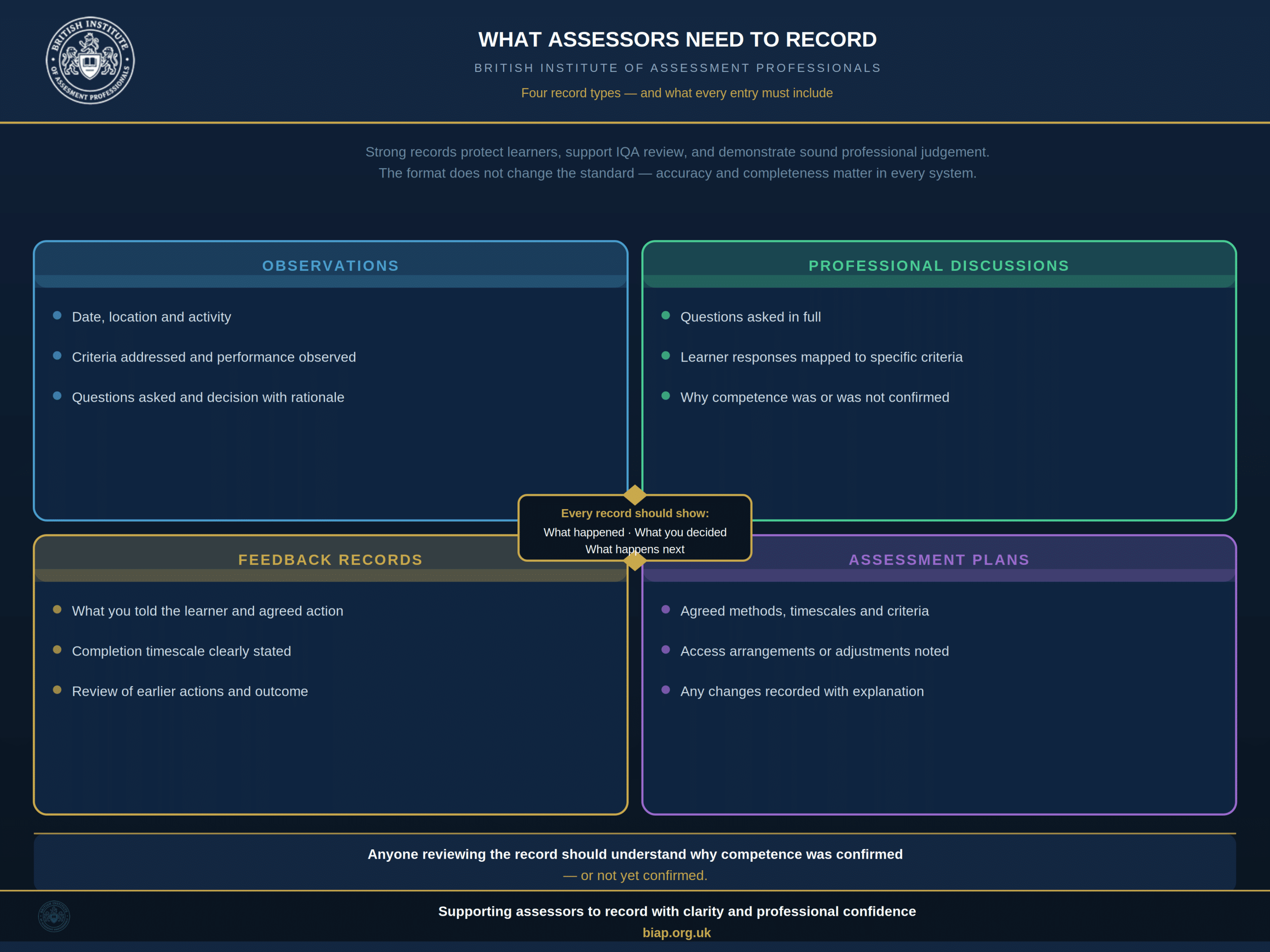
Infographics for assessors and IQAs
Practical, printable references covering assessment, IQA sampling, CPD and professional standards.
Built by BIAP, free to download and share.
Quick-Reference Guides for Vocational Assessment Professionals
BIAP’s infographic library brings together free, downloadable visual guides designed for assessors, internal quality assurers (IQAs) and anyone working towards a career in vocational assessment. Each infographic distils a core area of assessment or IQA practice into a clear, practical reference you can print, save, or share with your team — no jargon, no fluff, just the essentials laid out at a glance.
Structured to support your role
The collection is organised into four themes. Becoming an Assessor resources help newcomers compare qualification routes (TAQA, CAVA and IQA), decide between CPD and formal qualification, and know what questions to ask before enrolling on a course. Practising Assessor guides cover the day-to-day of the role: verifying competence, checking evidence validity, building credibility, giving structured feedback, responding to safeguarding disclosures, and keeping accurate records. IQA and Quality infographics support internal quality assurers with sampling frameworks, audit structure, centre approval steps and the core responsibilities of the IQA role. CPD & Development resources turn ongoing learning into genuine, evidenced progress — covering the CPD cycle, what to include in a CPD plan, and the right questions to ask of every CPD entry.
Clear Infographics
Topics include authenticity and evidence checks, professional judgement, sampling records, feedback structures and record-keeping requirements — the everyday decisions assessors and IQAs are expected to get right, presented as simple, memorable frameworks rather than dense policy text.
High -Resolution Images and PDF’s
Every infographic is available as a high-resolution PNG for screen use or an A3 PDF for printing and display in training rooms, offices or assessment centres. They’re built by BIAP — the British Institute of Assessment Professionals — as free, shareable tools to support best practice across the sector, whether you’re new to assessment, an experienced practitioner, or quality assuring others’ work.
Browse, Download, Use and Share
Browse the full set, filter by category, and download the guides most relevant to your role — ideal for CPD evidence, induction packs, staff training, or as quick prompts pinned near your desk.

5 Sources of Occupational Competence Evidence
See the five evidence sources every assessor should draw on for occupational competence — from direct observation to witness testimony. BIAP guide.
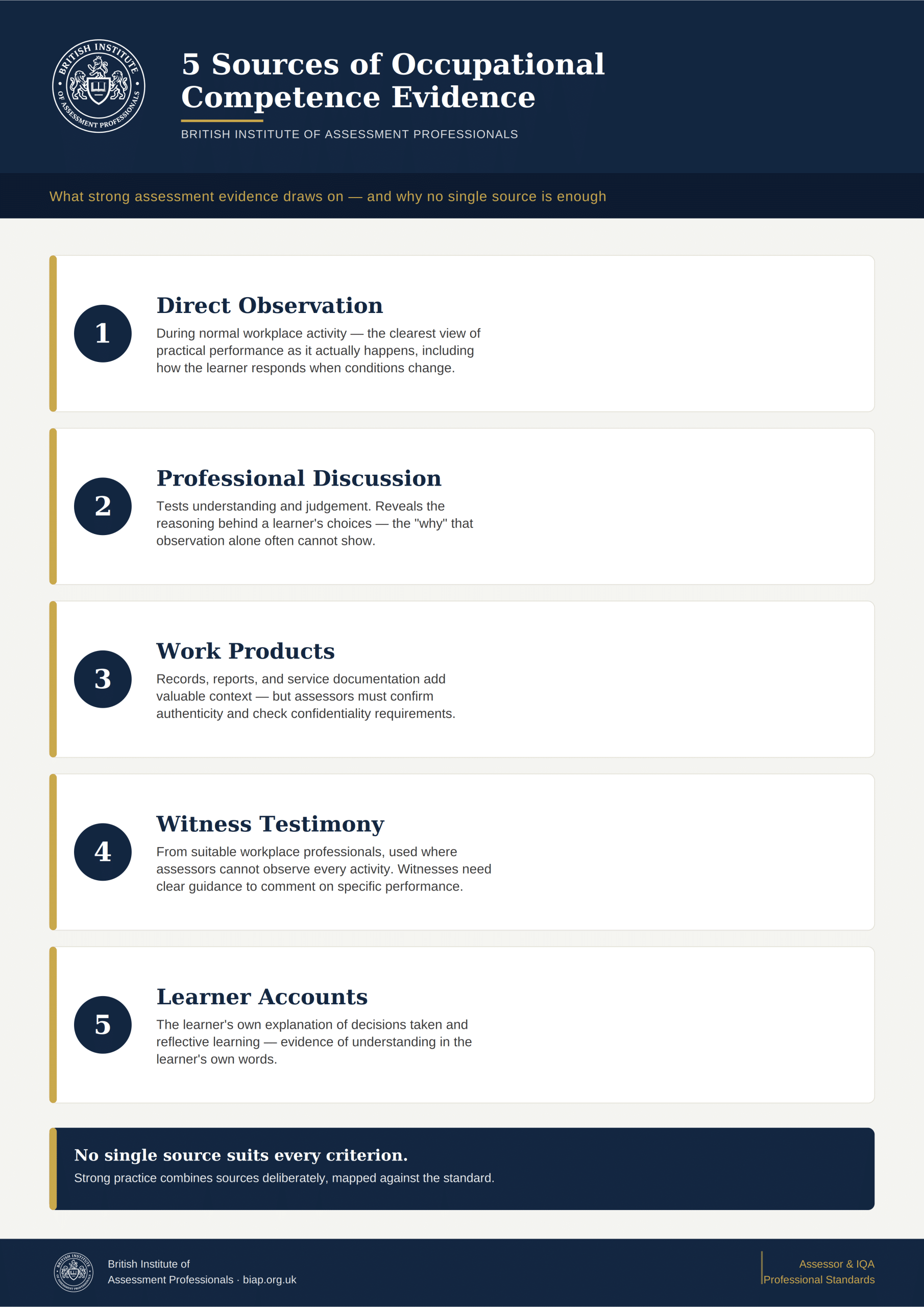

7 Steps to Assessment Centre Approval
A practical roadmap from confirming the approval route through to treating approval as day one, not the finish line.
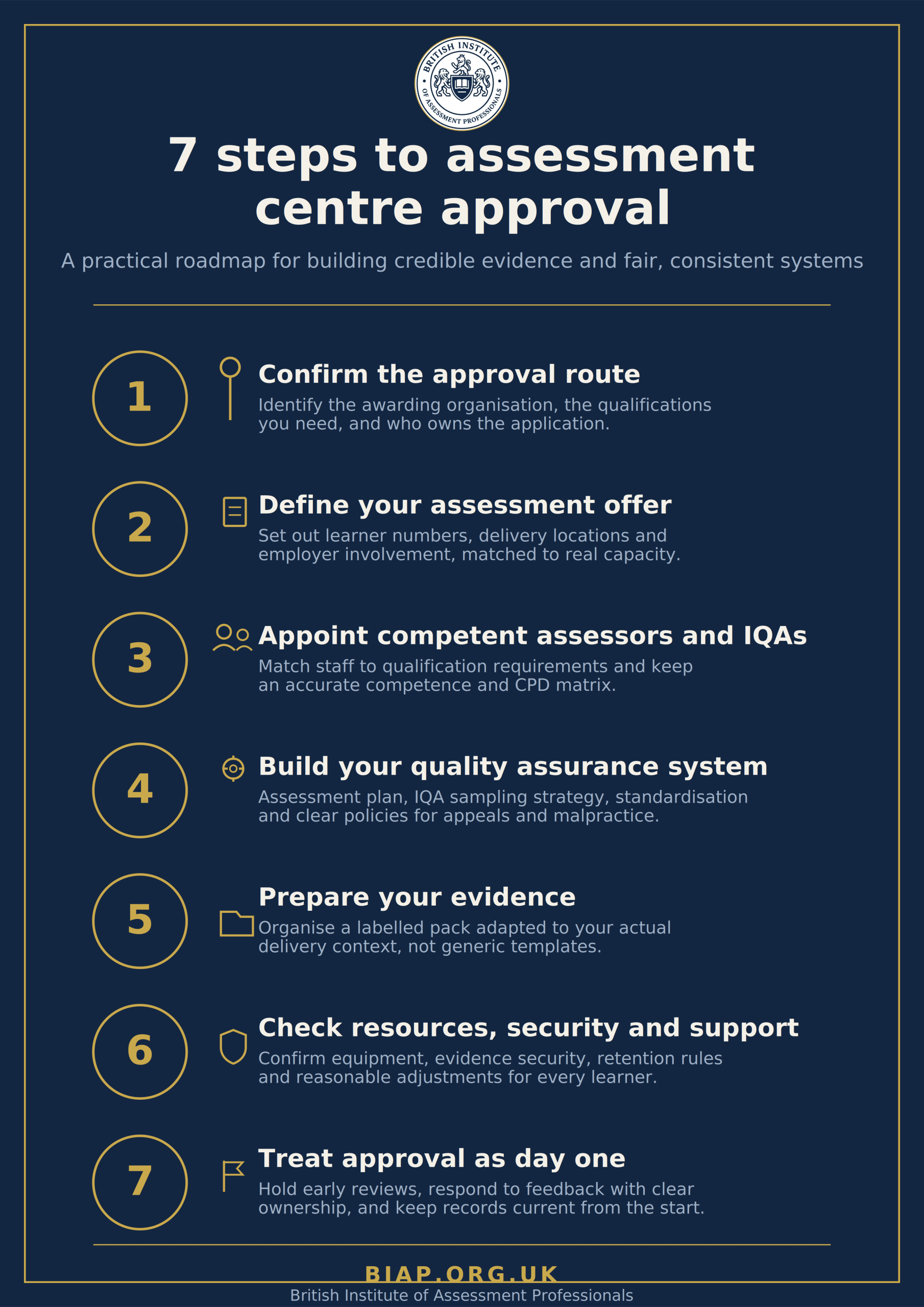

Assessor Credibility: Built or Lost
Five ways credibility is built through consistent practice, set against five habits that lose it much faster.

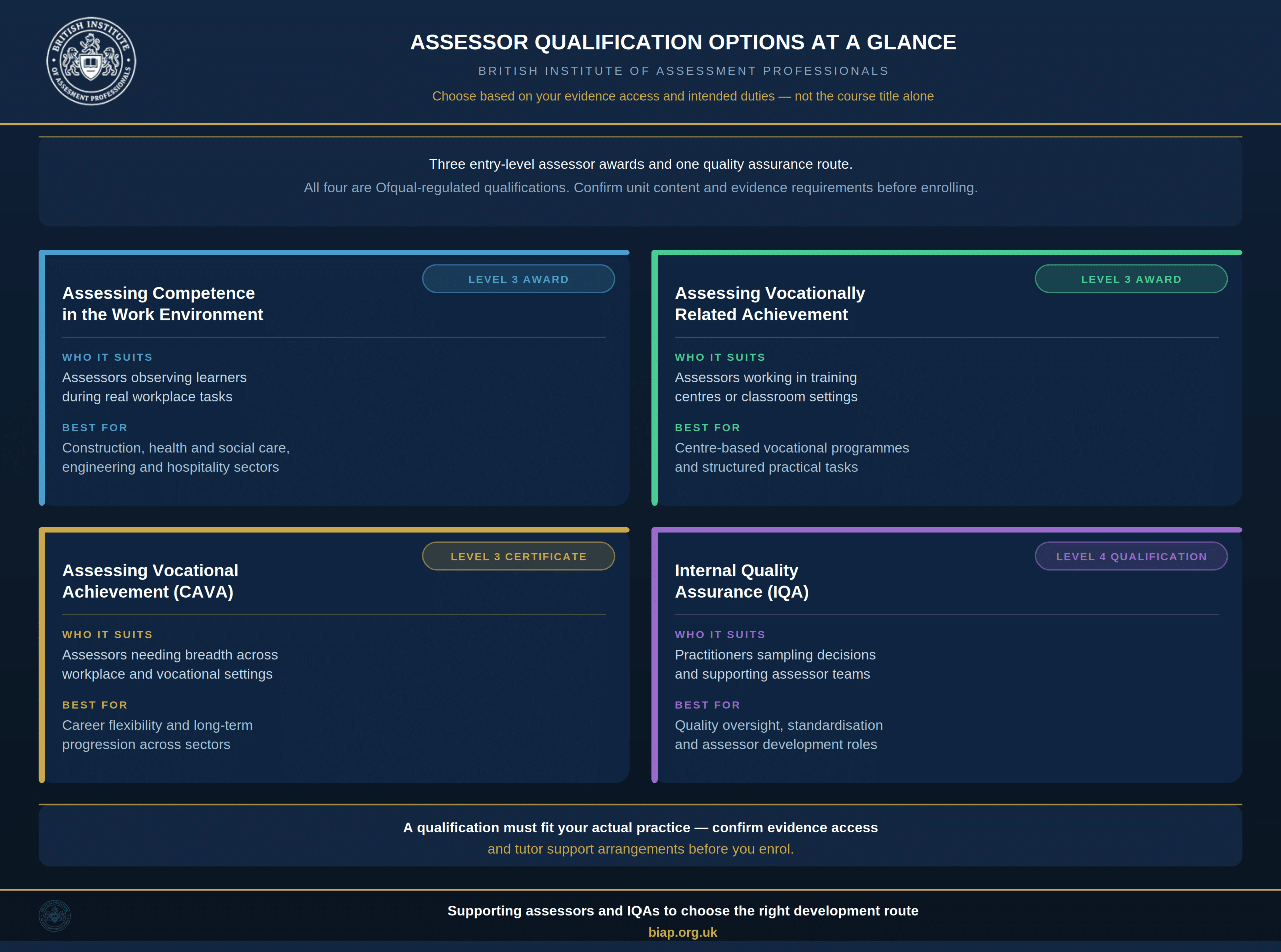
Assessor Qualification Options at a Glance
TAQA, CAVA and IQA compared side by side — who each route suits and which sectors it fits best.

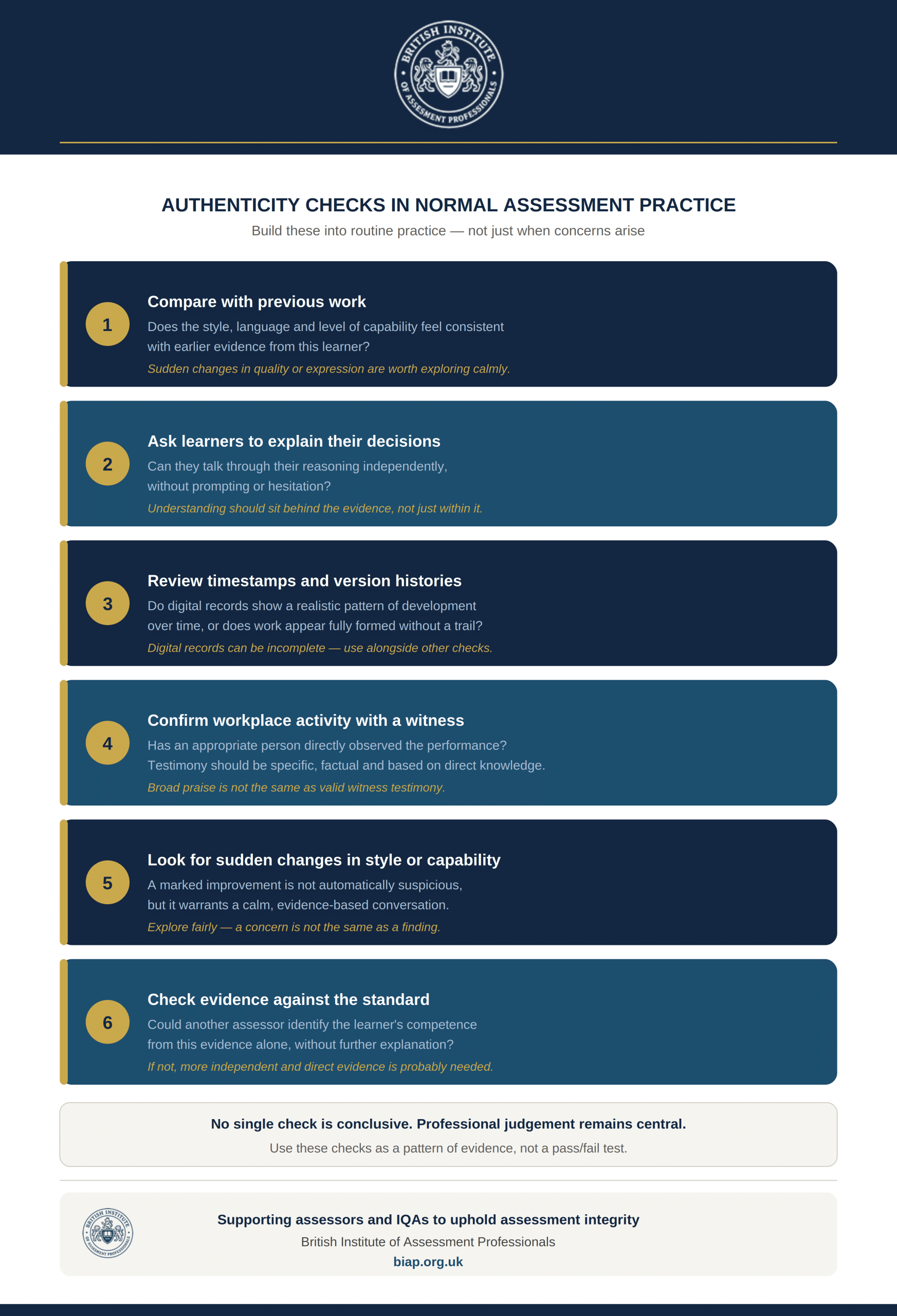
Authenticity Checks in Normal Assessment Practice
Six checks to build into routine practice — not just when concerns arise — for confirming evidence is genuinely the learner's own.

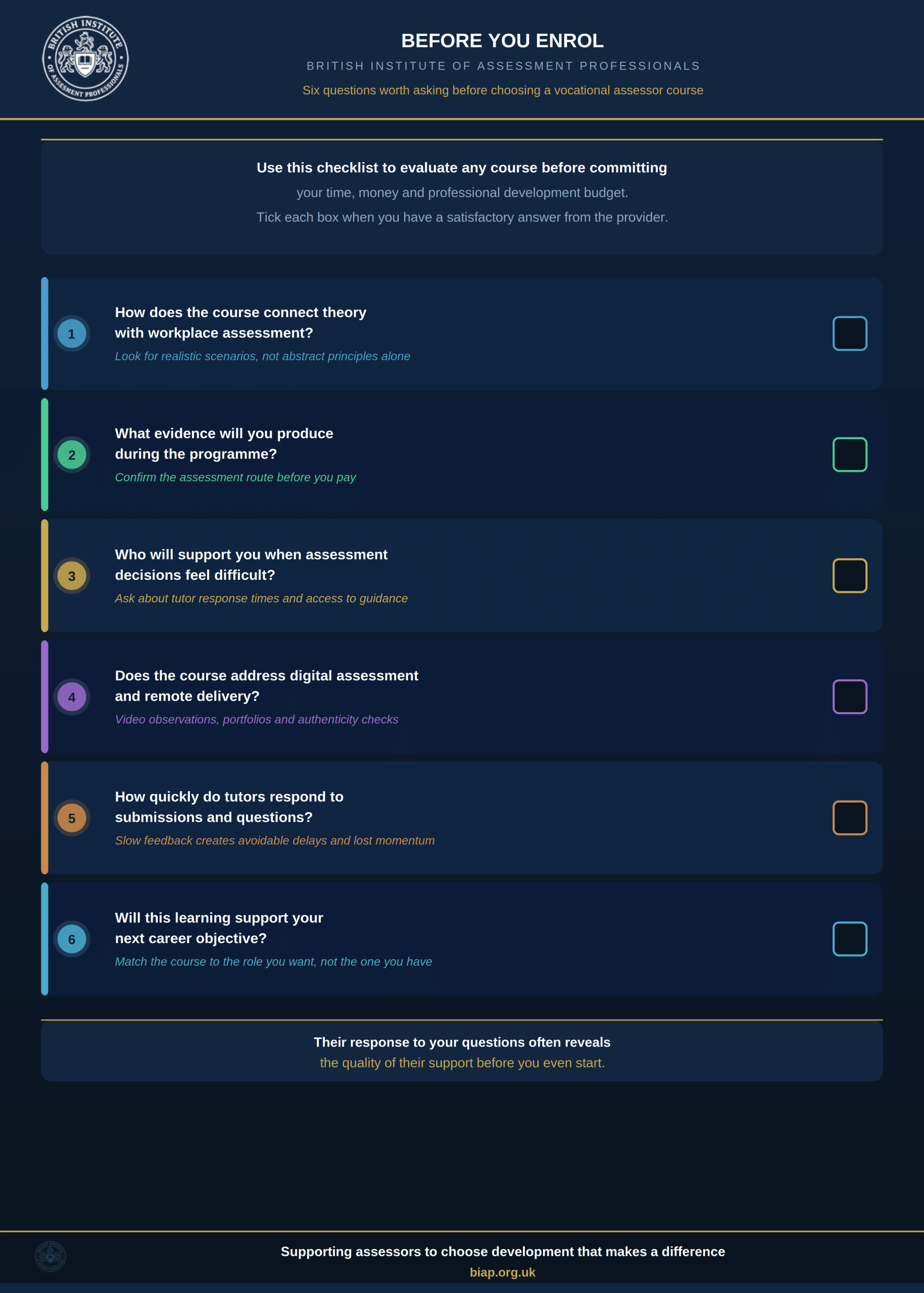
Before You Enrol: Six Questions Worth Asking
A tick-box checklist for evaluating any vocational assessor course before committing your time and money.

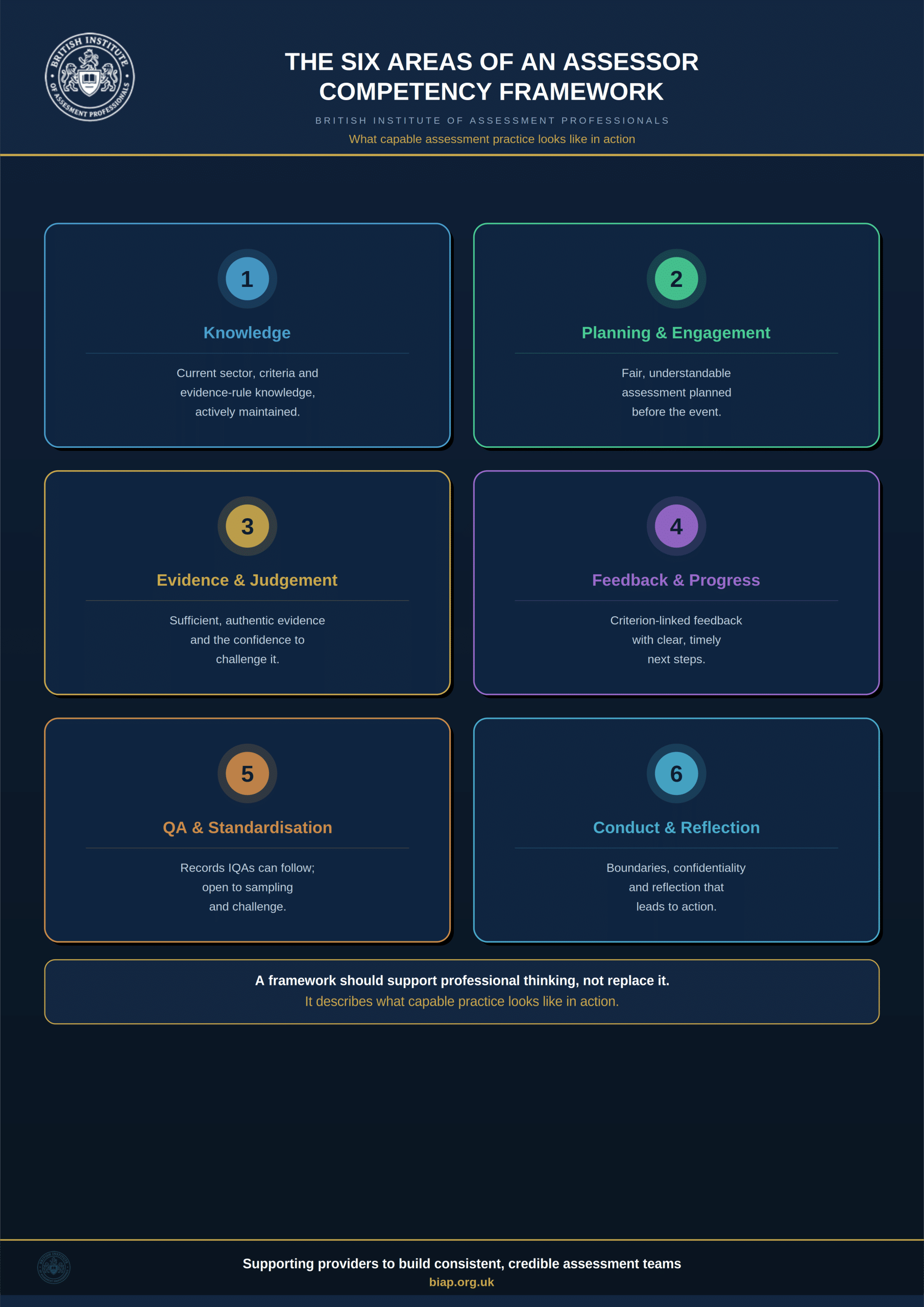
Building an Assessor Competency Framework That Works
A good framework turns vague feedback into focused development. The six capability areas that define capable assessment — and how to introduce them well.

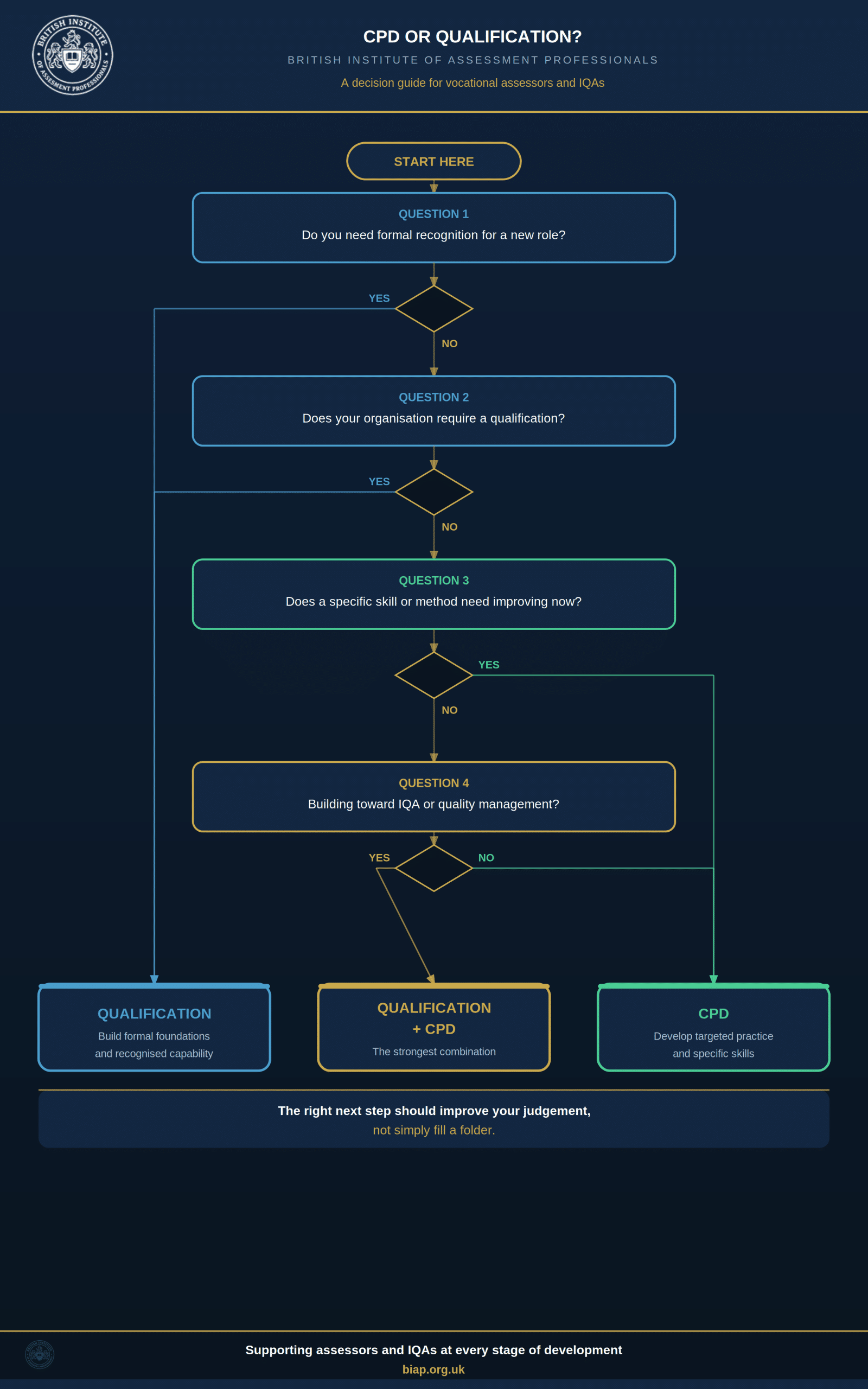
CPD or Qualification?
A decision guide working through four questions to point you toward CPD, a formal qualification, or both.

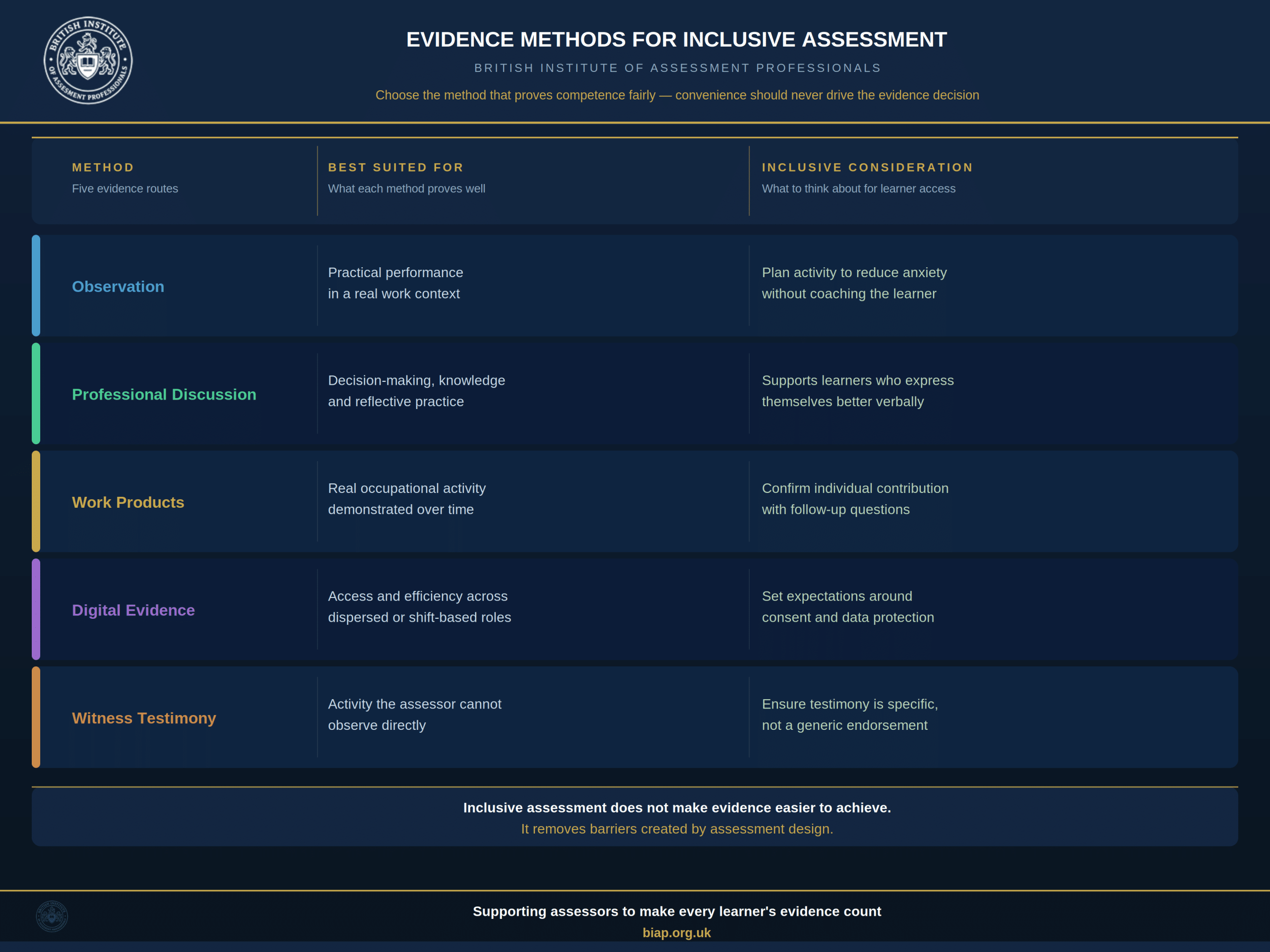
Evidence Methods for Inclusive Assessment
Five evidence routes compared, with what each proves best and how to keep it accessible for every learner.

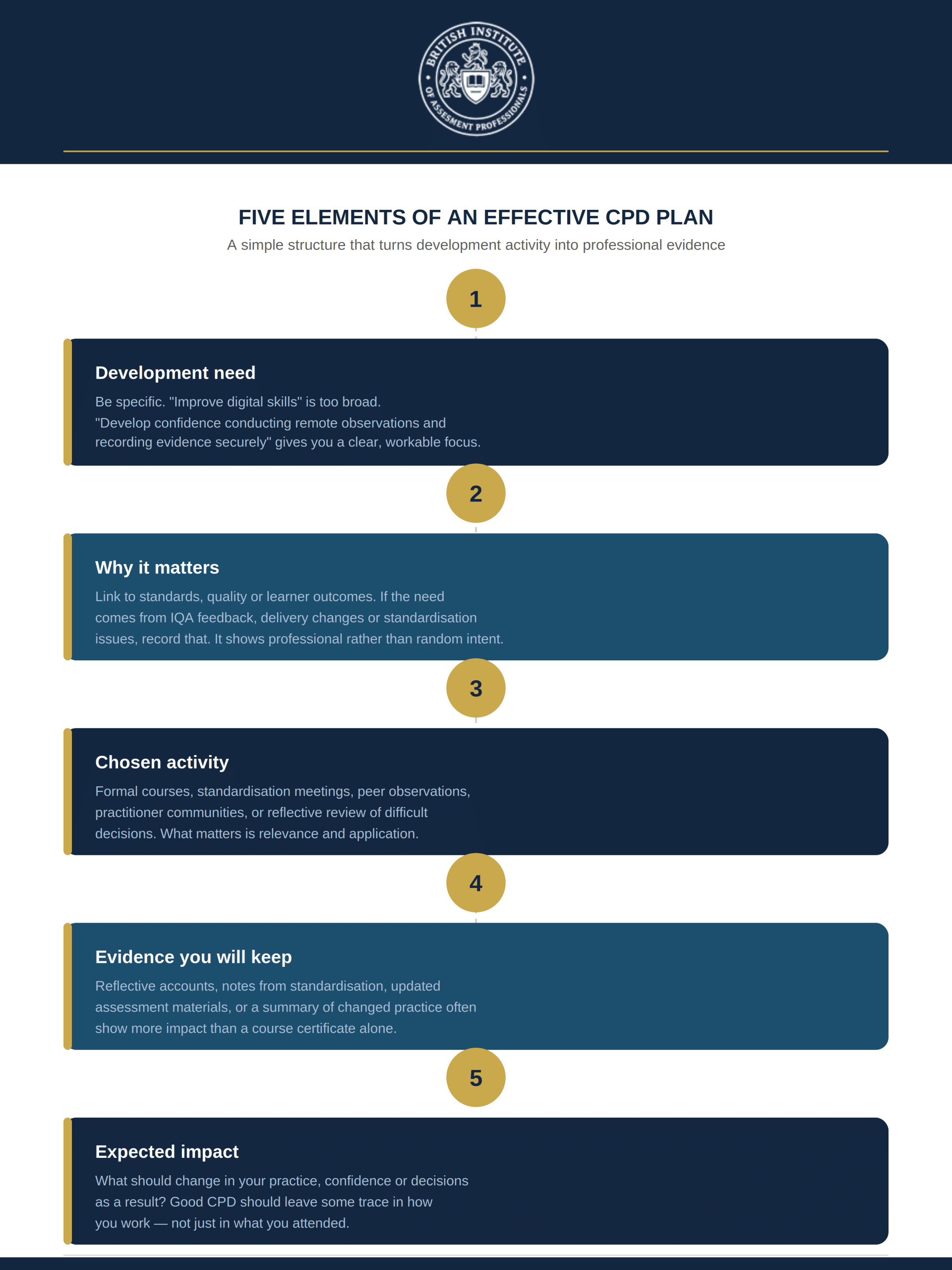
Five Elements of an Effective CPD Plan
From development need through to expected impact — a simple structure that turns CPD activity into professional evidence.

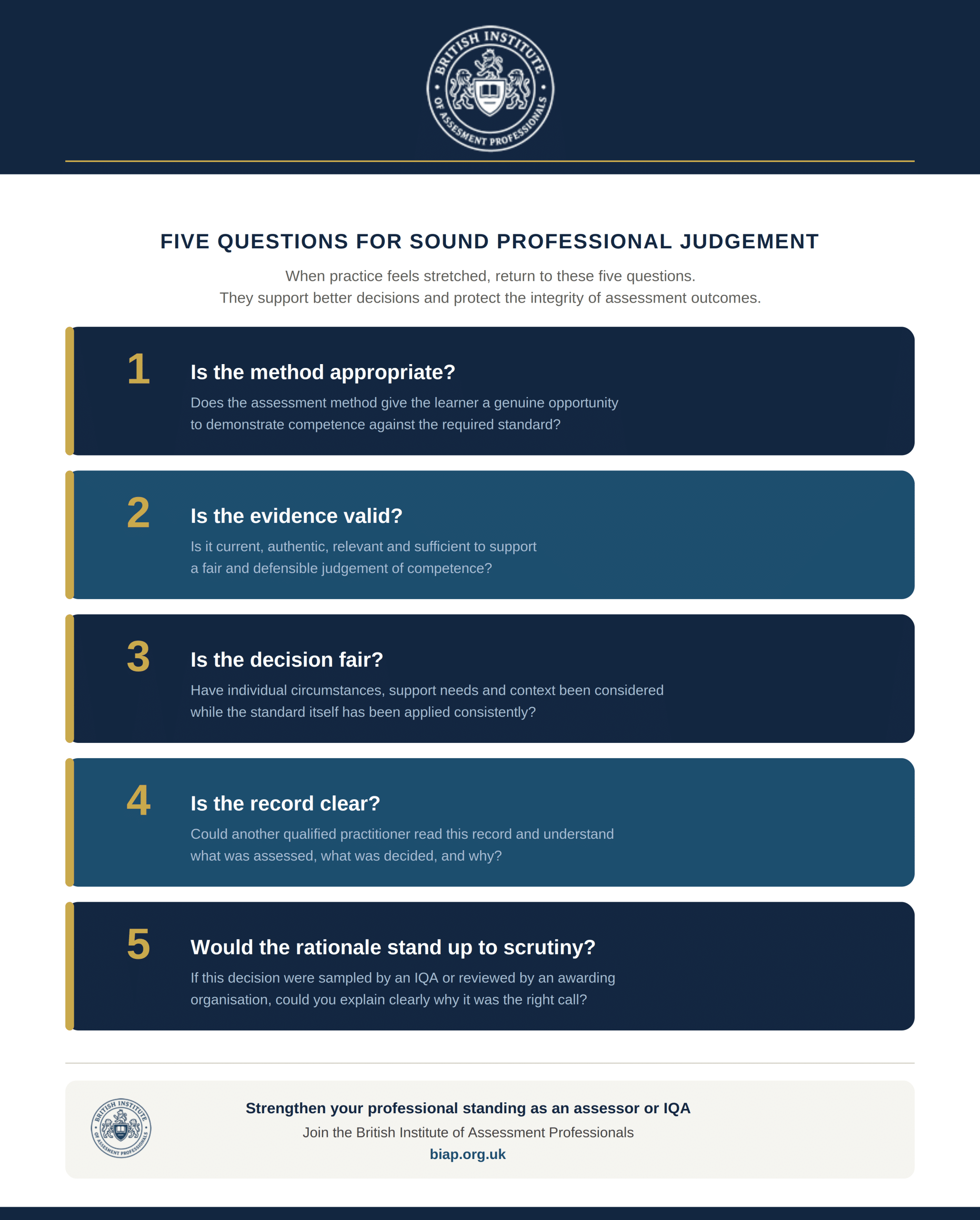
Five Questions for Sound Professional Judgement
Method, evidence, fairness, record and rationale — five questions to return to whenever an assessment decision feels stretched.

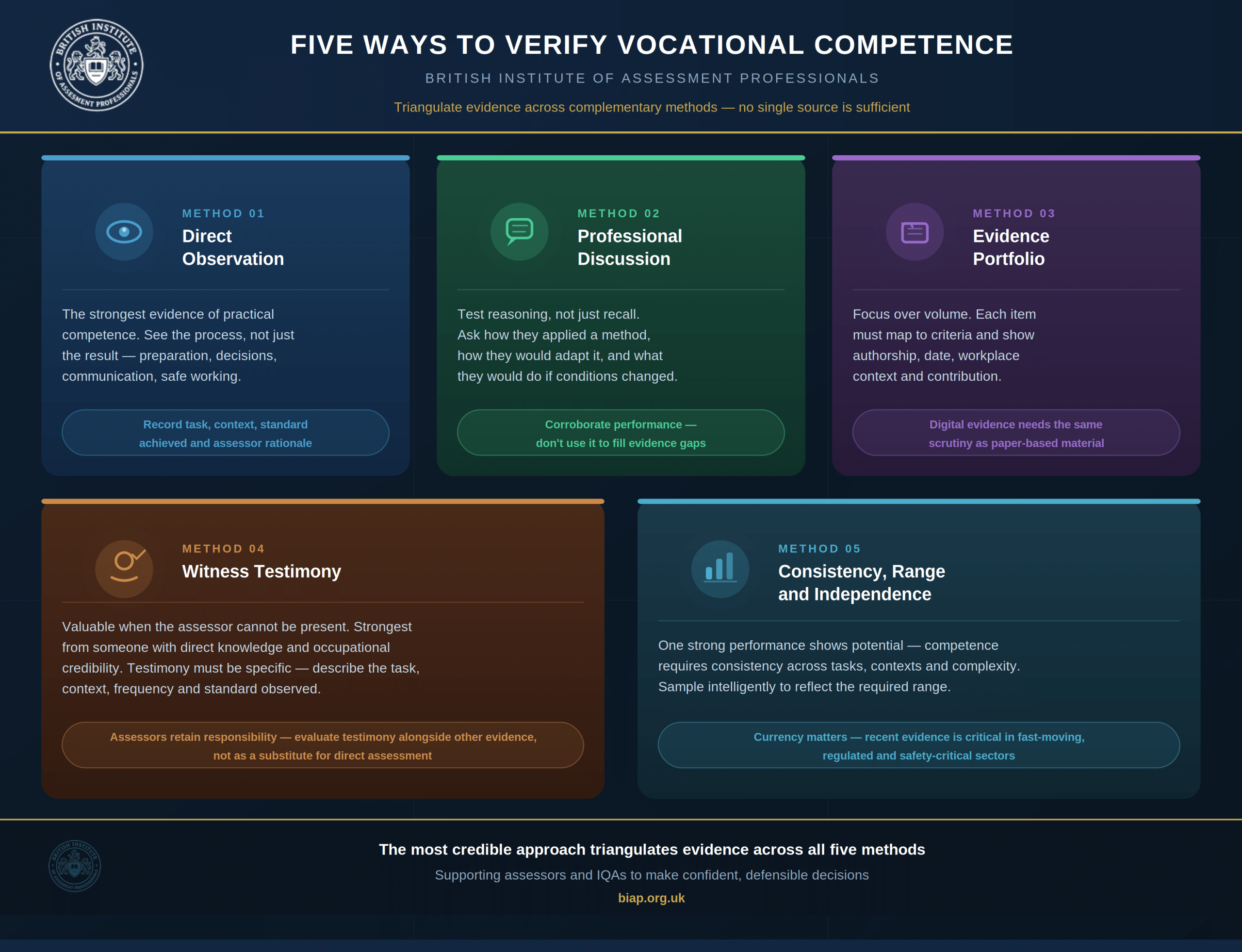
Five Ways to Verify Vocational Competence
Observation, discussion, portfolio, witness testimony and range — five methods that triangulate a confident, defensible decision.

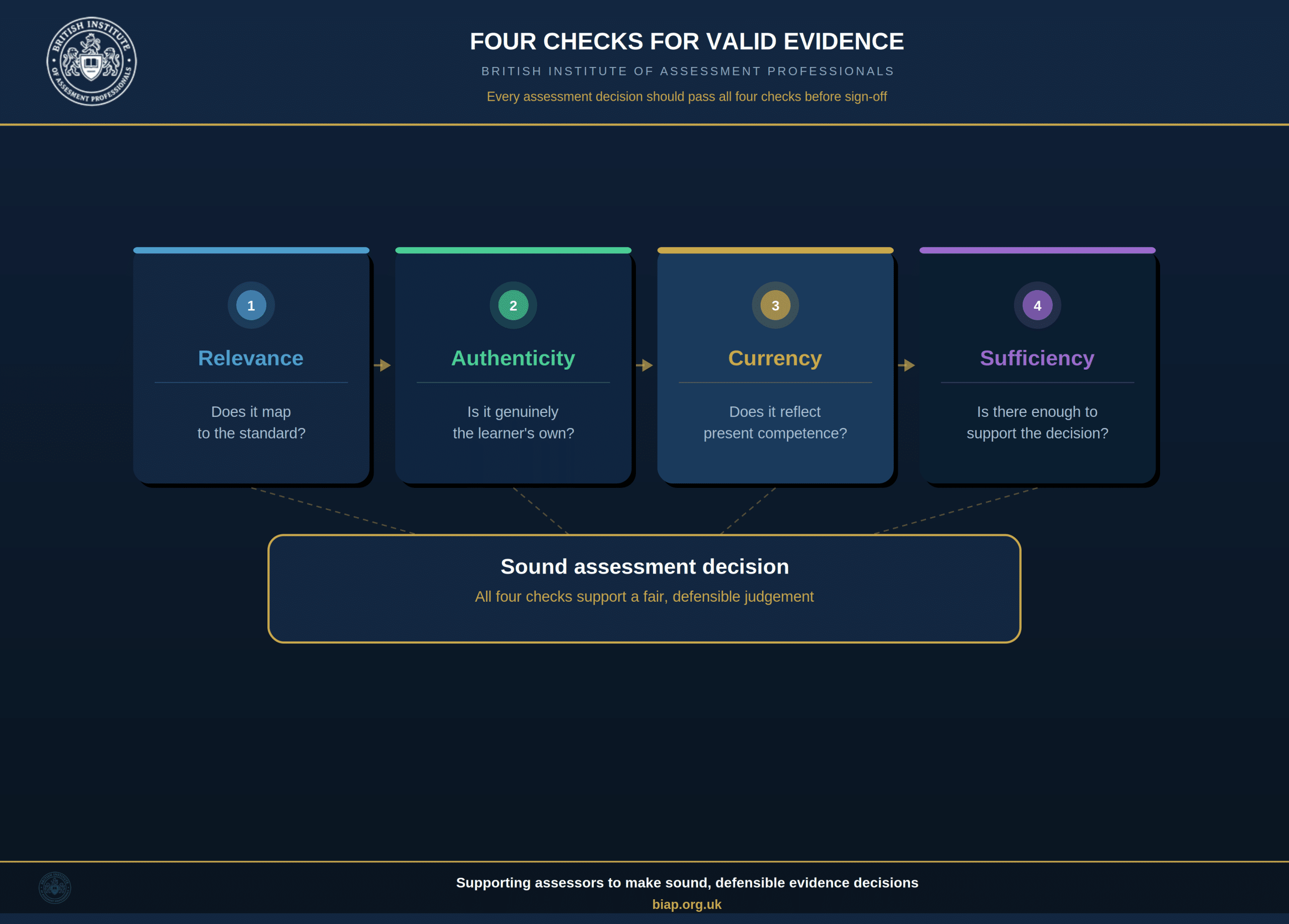
Four Checks for Valid Evidence
Relevance, authenticity, currency and sufficiency — the four questions every piece of evidence needs to pass.

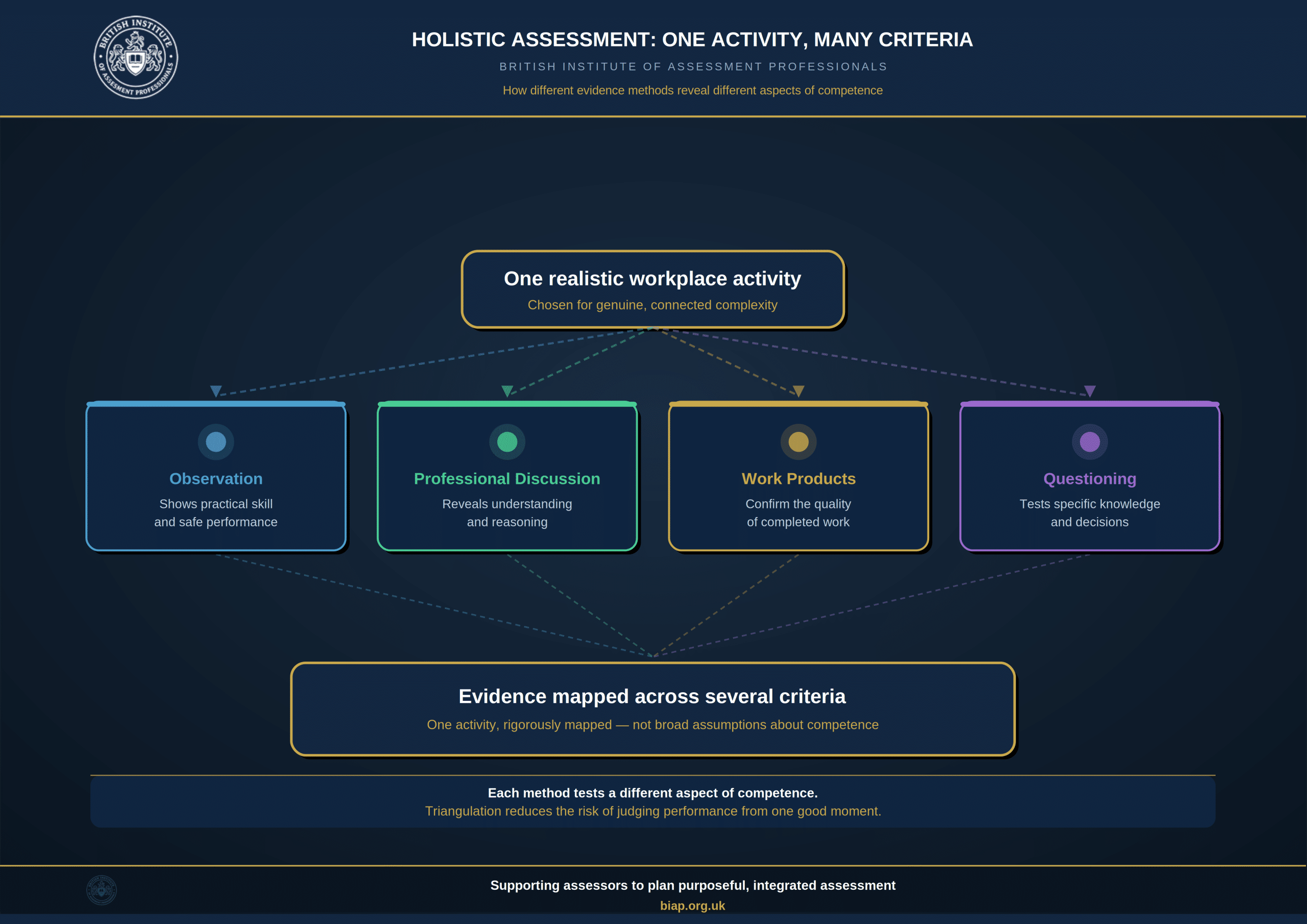
Holistic Assessment: One Activity, Many Criteria
One activity, many criteria: observation, discussion, work products and questioning each reveal a different aspect of competence — efficient and rigorous.

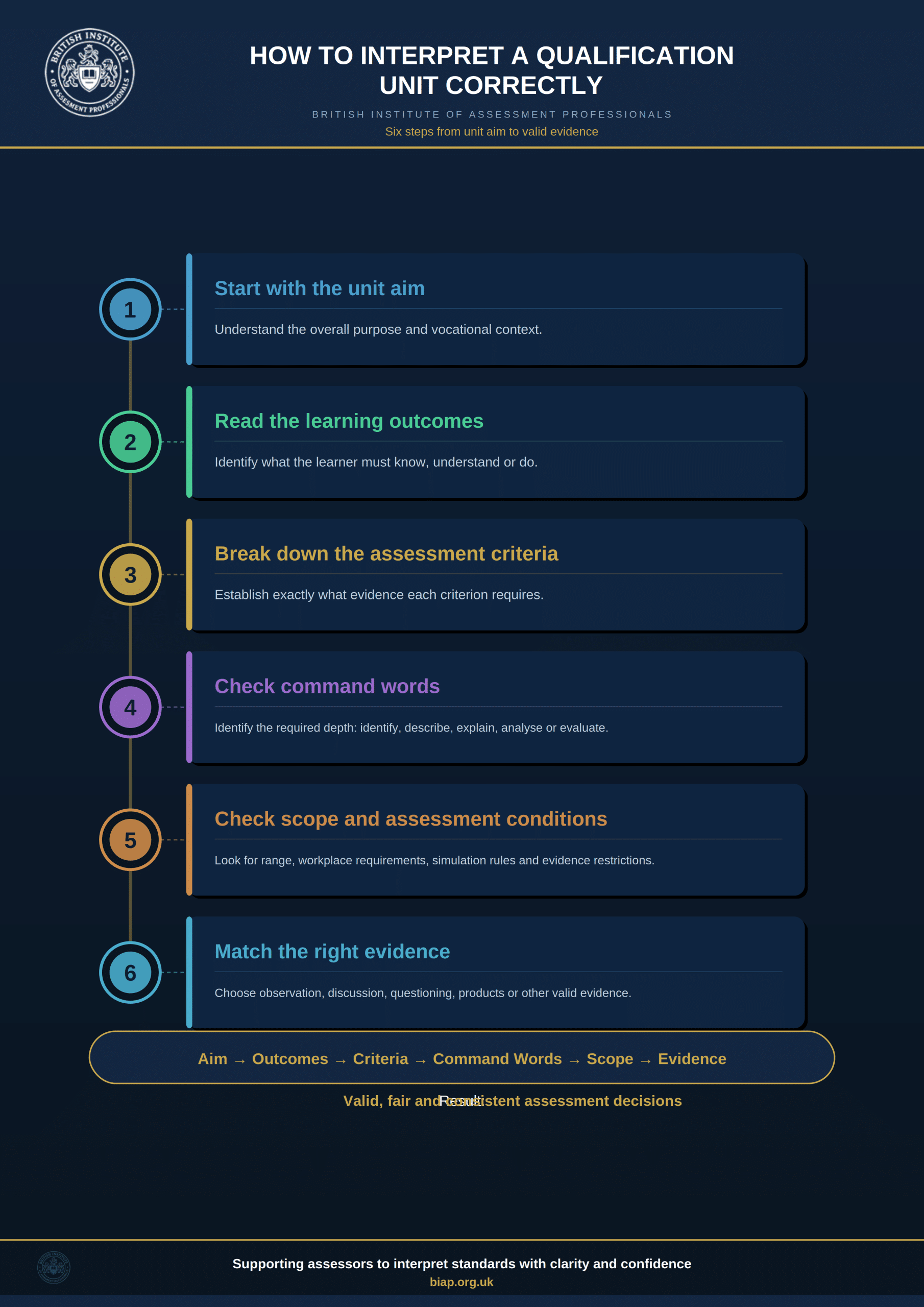
How to Interpret Vocational Qualification Units
Six-step infographic from the British Institute of Assessment Professionals showing how to interpret vocational qualification units correctly and match the right evidence.

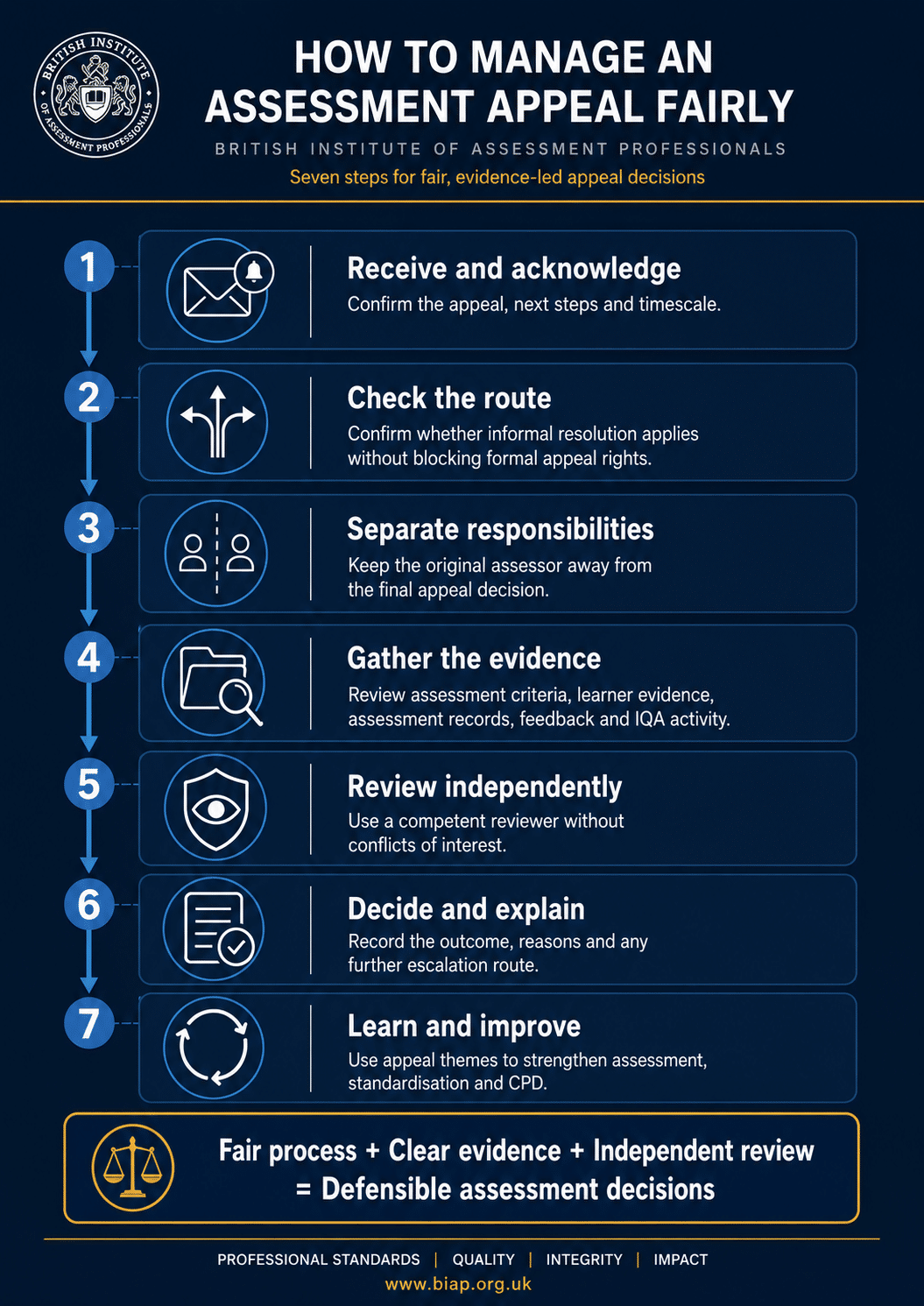
Manage assessment appeals fairly and consistently
Manage assessment appeals fairly and consistently. Learn how to review evidence, protect learner rights, record decisions and strengthen assessment practice.

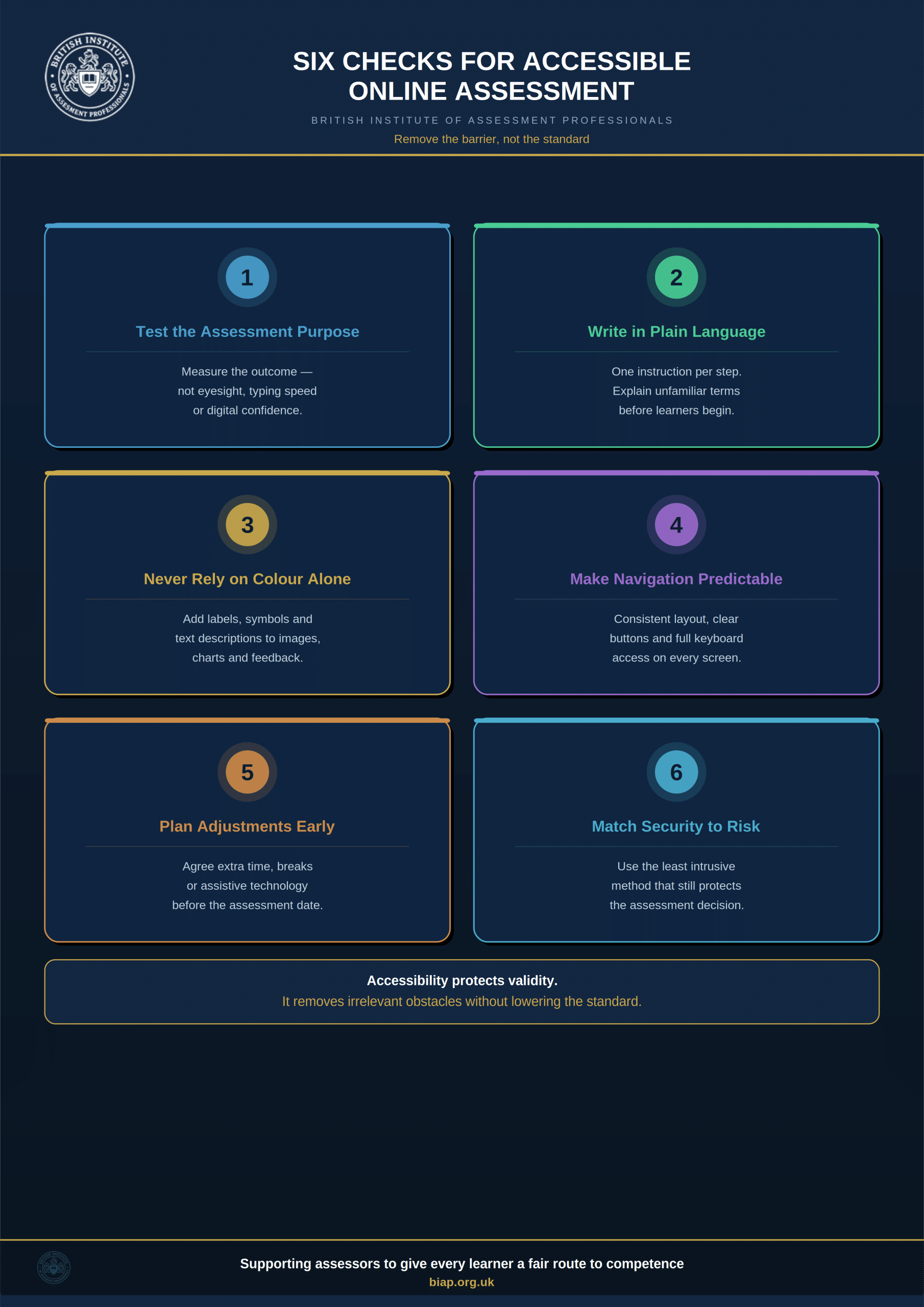
Online Assessment Accessibility: A Practical Guide for Assessors
Accessibility protects validity, not just fairness. Six practical checks to remove digital barriers without lowering the standard your assessment must test.

Quality Assurance Risks in Assessment (and How to Manage Them)
Weak planning, thin evidence, inconsistent decisions: the five quality assurance risks that grow through ordinary pressure — and the control for each one.

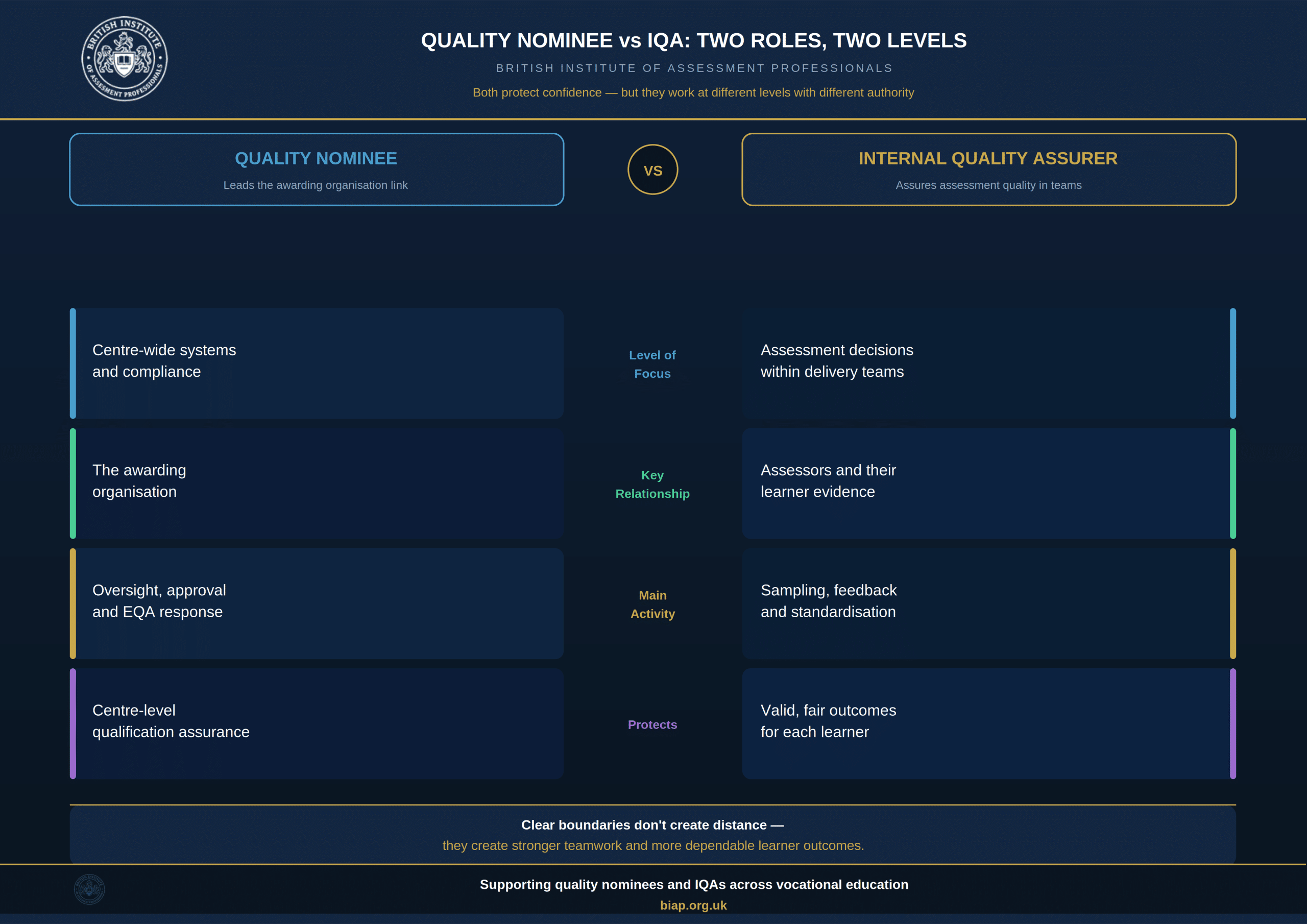
Quality Nominee vs IQA: Two Roles, Two Levels
Quality Nominee or IQA? One leads centre-wide systems and the awarding organisation link; the other assures assessment decisions. Different levels, same goal.

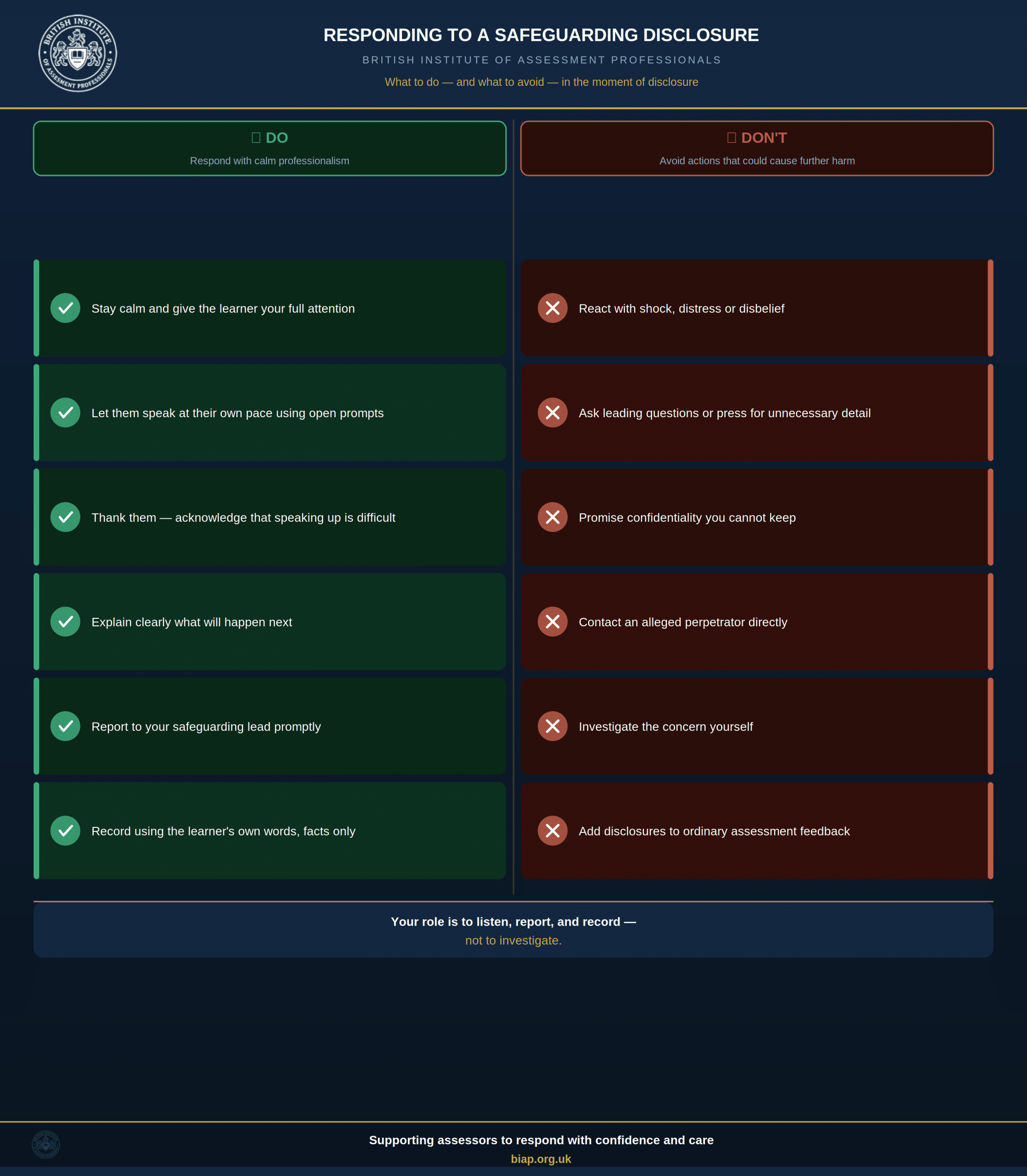
Responding to a Safeguarding Disclosure
What to do and what to avoid in the moment a learner discloses — listen, report and record, don't investigate.

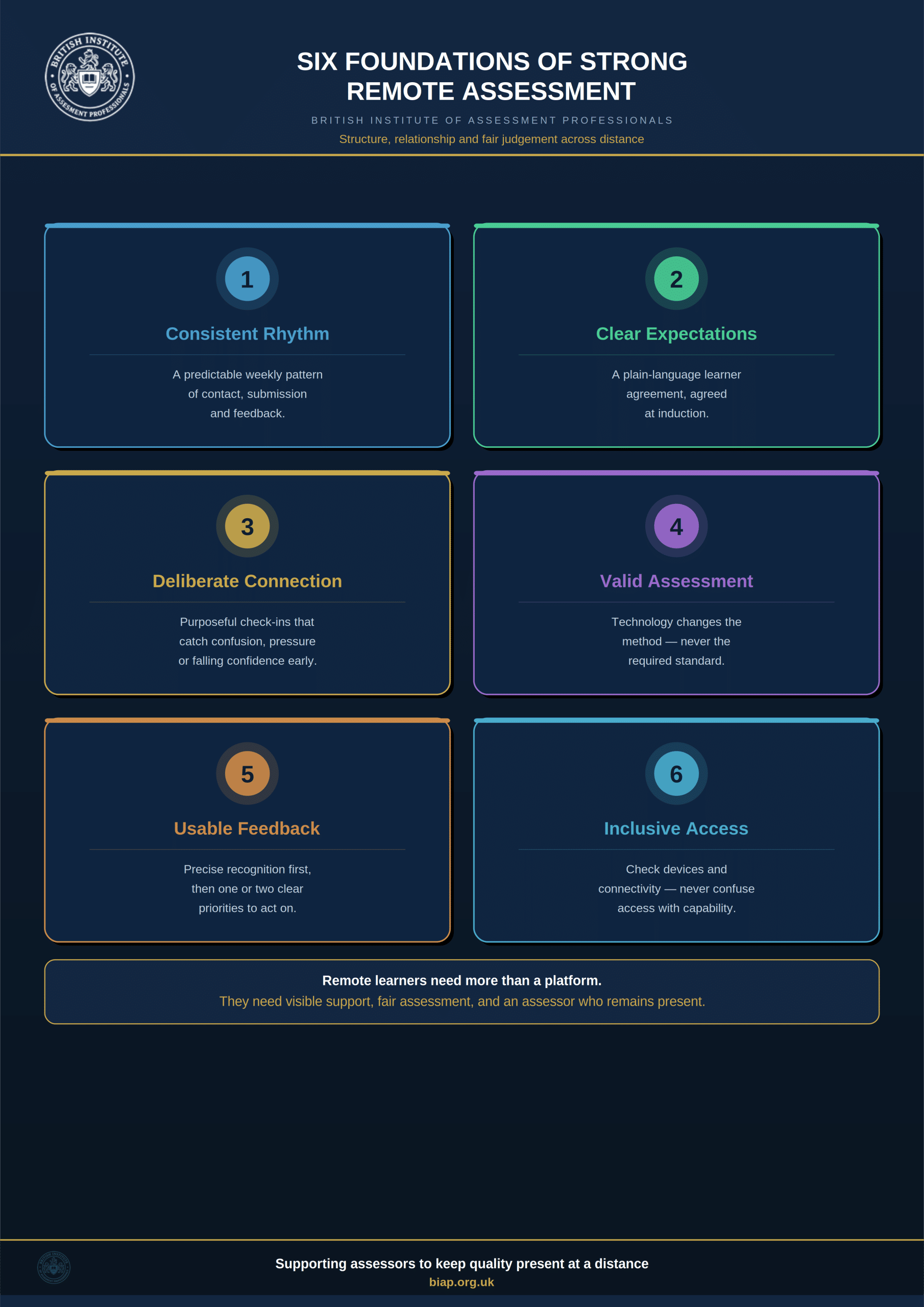
Six Foundations Of Strong Remote Assessment
Remote learners need more than a platform. Consistent rhythm, deliberate connection and valid assessment keep quality and the assessor present across distance.

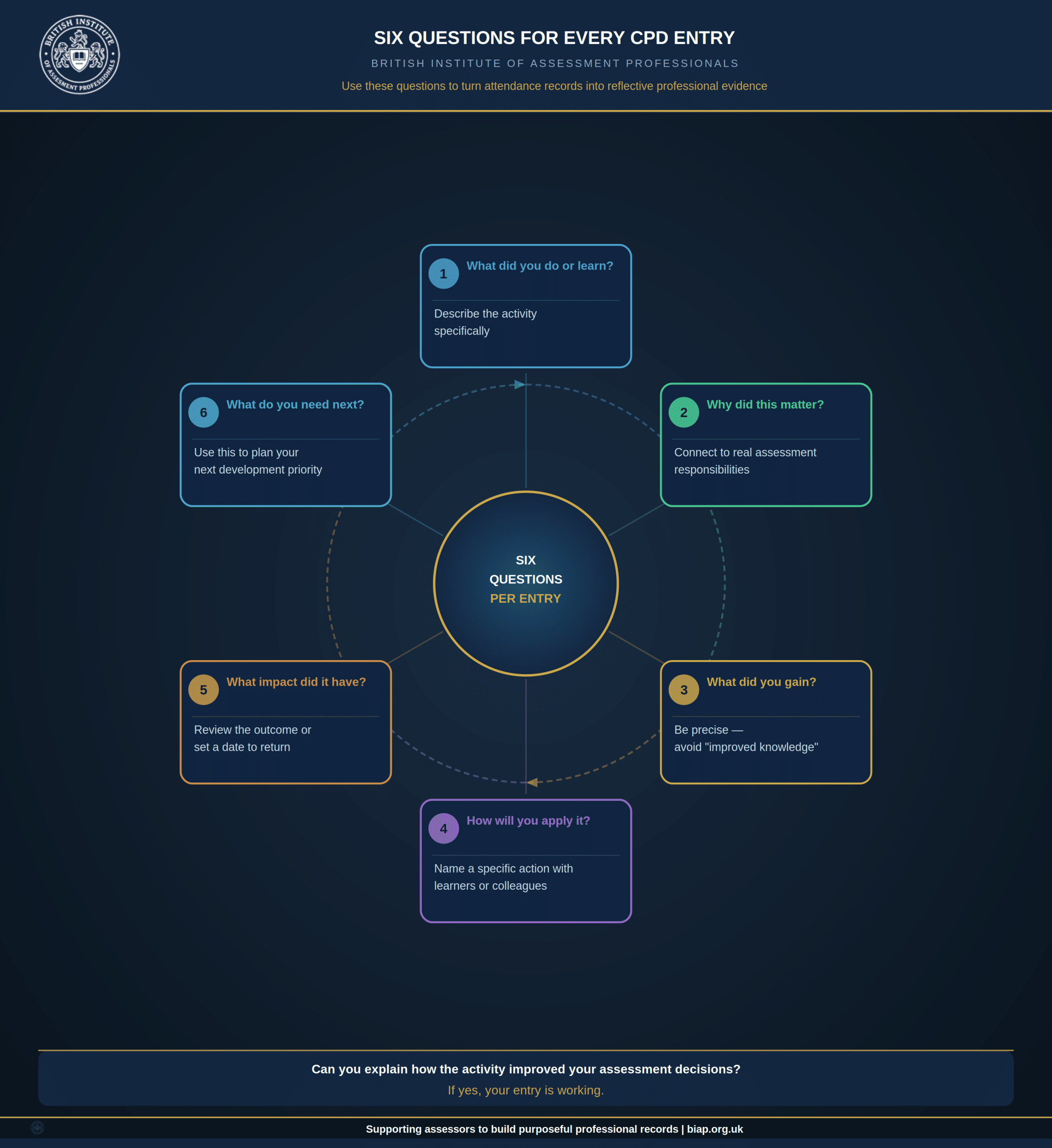
Six Questions for Every CPD Entry
Turn attendance records into reflective evidence — six questions to work through for every CPD activity you log.

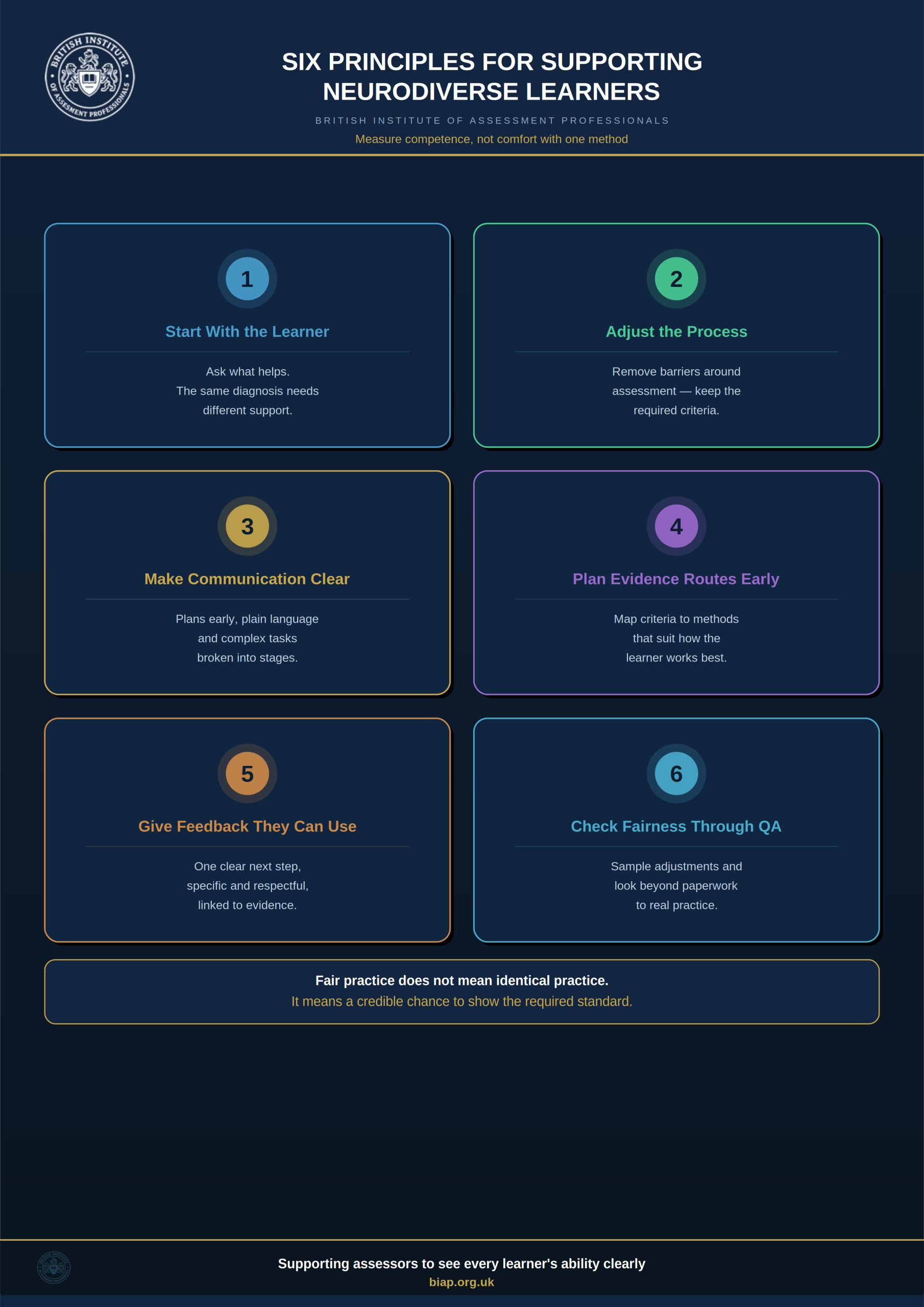
Supporting Neurodiverse Adult Learners in Assessment
Assessment should measure competence, not comfort with one method. Six principles for supporting neurodiverse learners; starting with the person, not the label

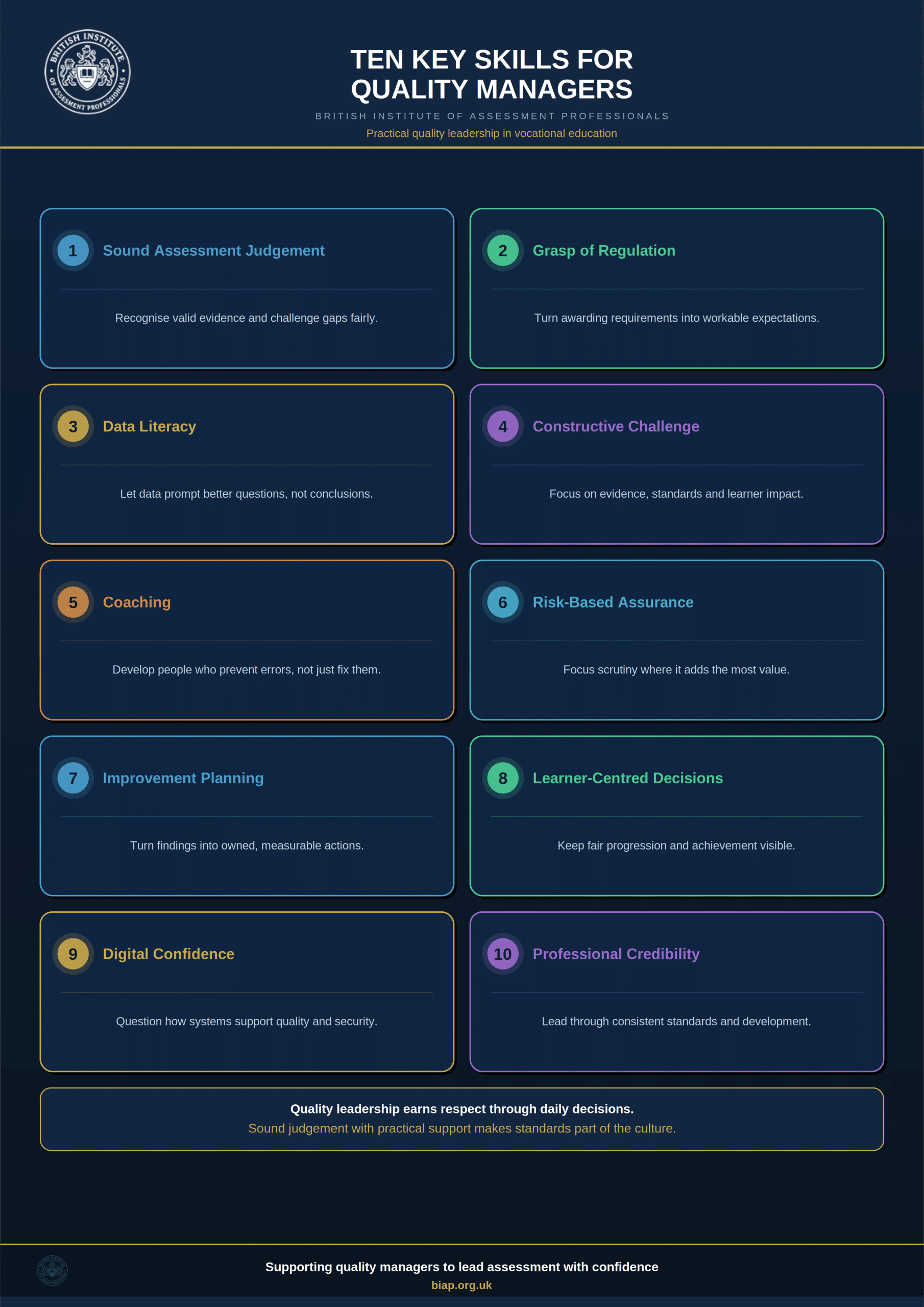
Ten Key Skills Every Quality Manager Needs
Quality leadership is practical, not just procedural. The ten skills — from sound judgement to coaching and risk-based assurance — that make standards stick.

The Best Questioning Techniques for Assessors
The right question uncovers real competence without leading the learner. Six techniques — open, probing, hypothetical and more — to test understanding fairly.

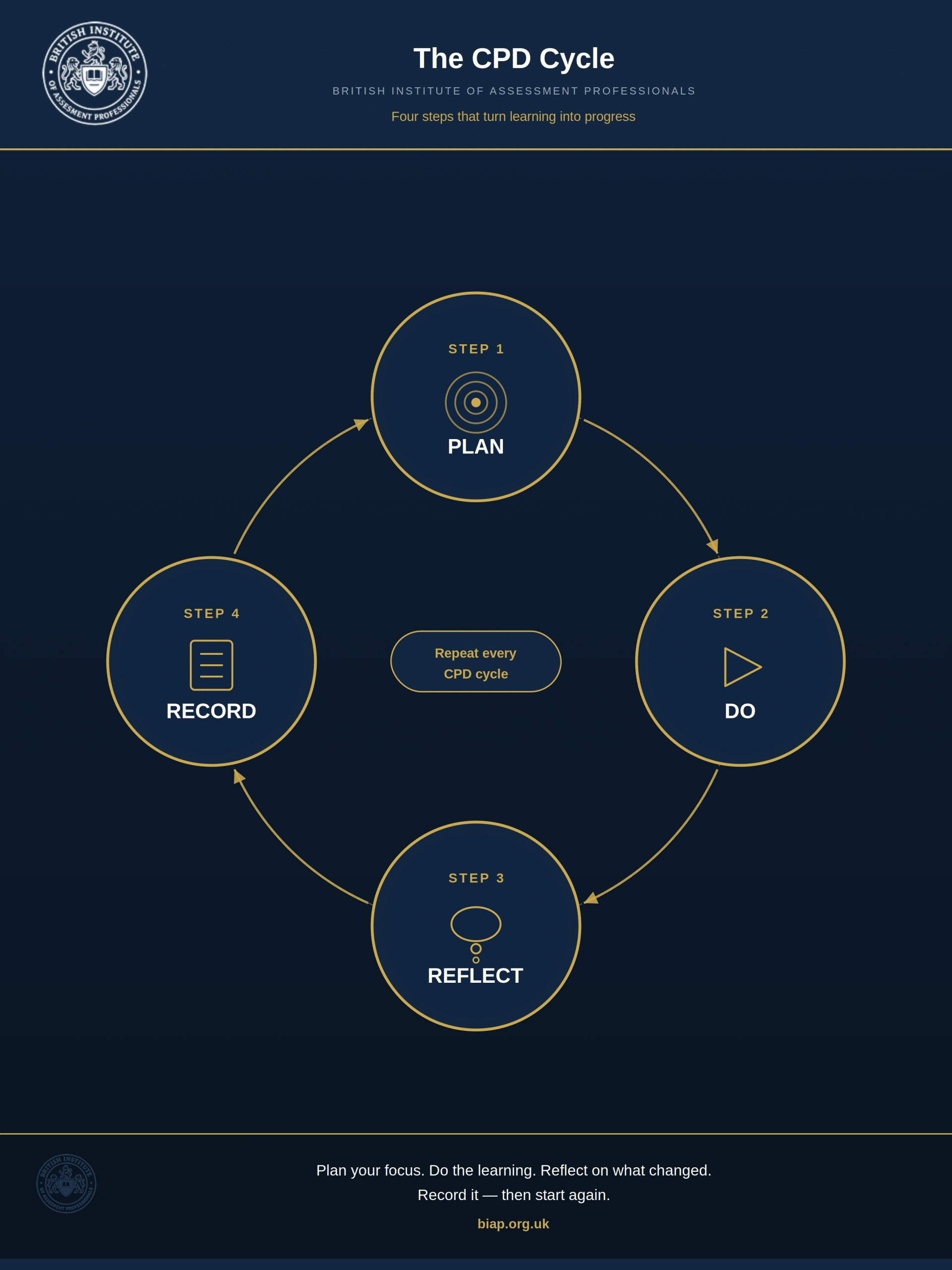
The CPD Cycle
Plan, Do, Reflect, Record — four repeating steps that turn CPD activity into genuine progress.

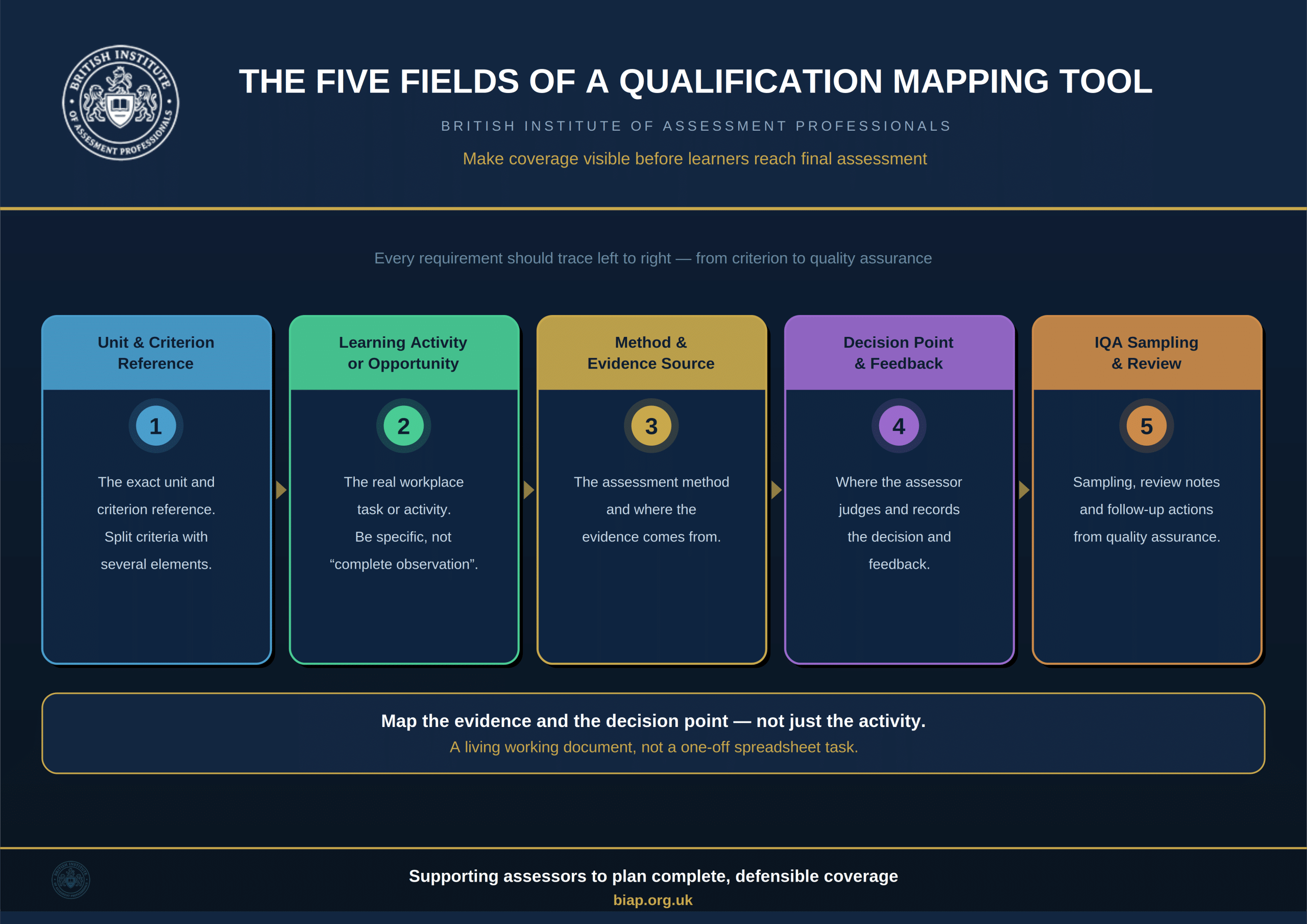
The Five Fields of an Effective Qualification Map
Qualification mapping makes evidence coverage visible before it's too late. The five fields of a working map

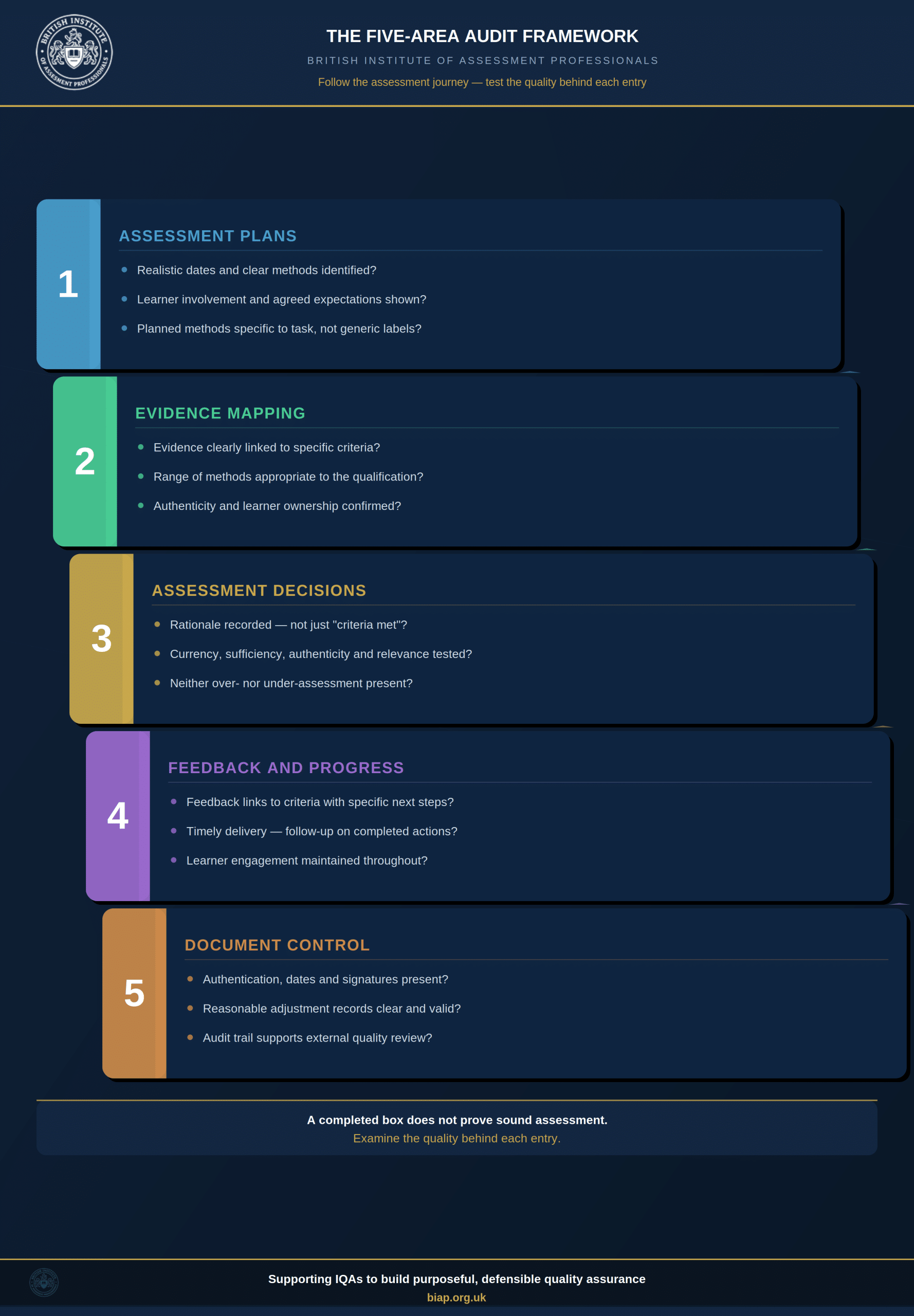
The Five-Area Audit Framework
From assessment plans through to document control — five stages of IQA sampling, each with its own quality checks.

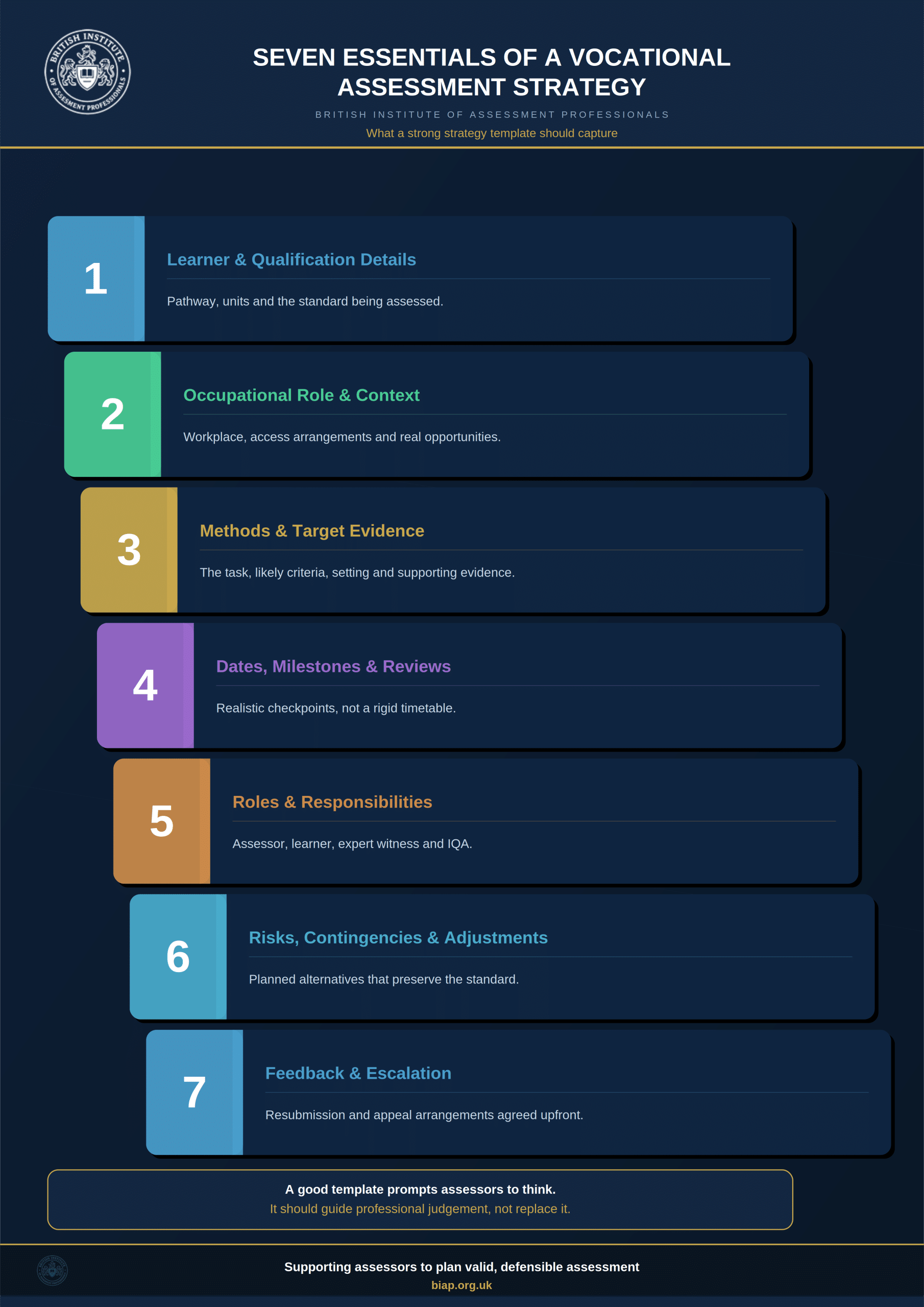
The Seven Essentials of a Vocational Assessment Strategy
A strong assessment strategy guides judgement without restricting it. The seven sections every template needs to map competence, not just complete paperwork.

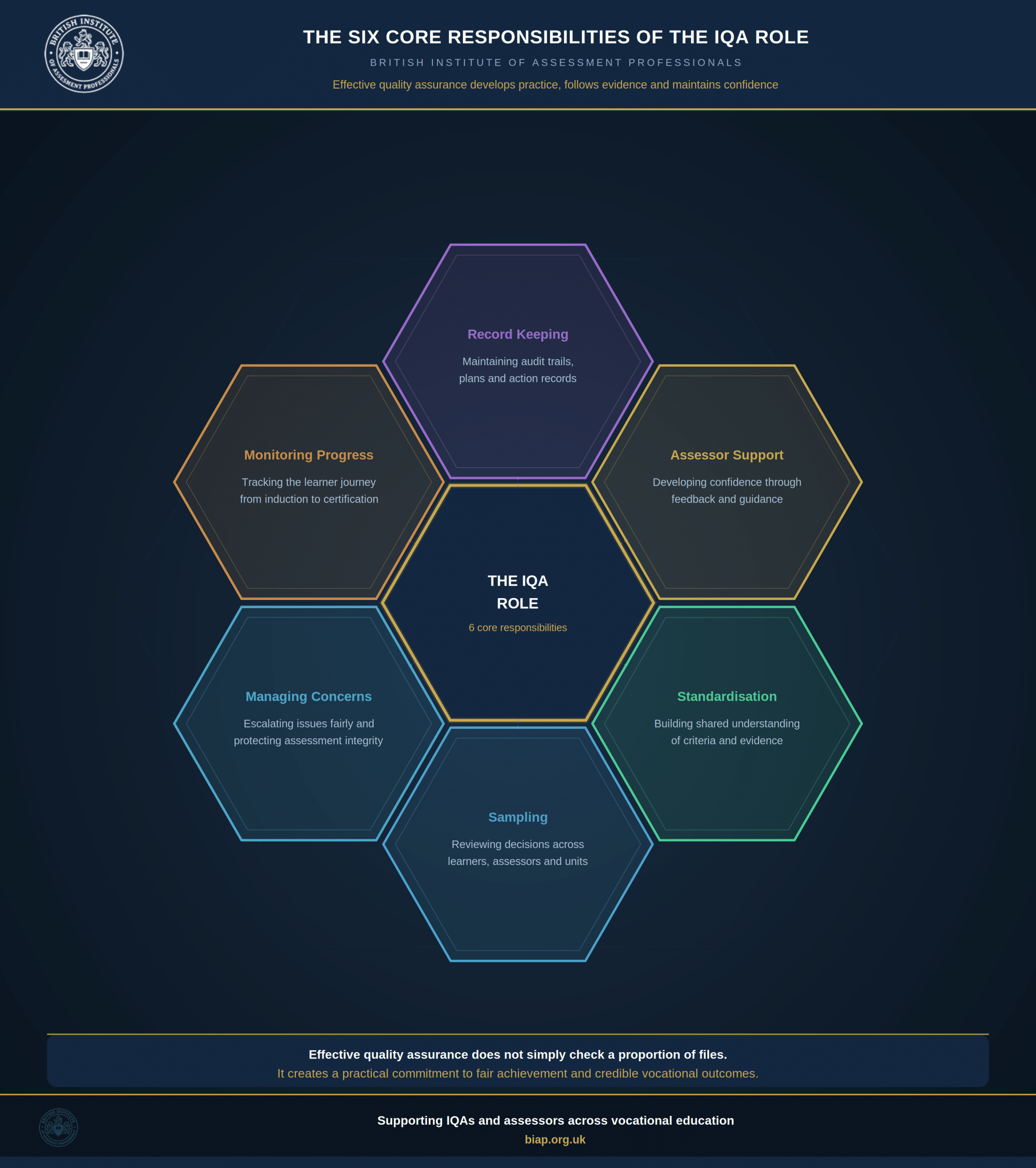
The Six Core Responsibilities of the IQA
Sampling, standardisation, record keeping and more — the six areas that make up effective internal quality assurance.

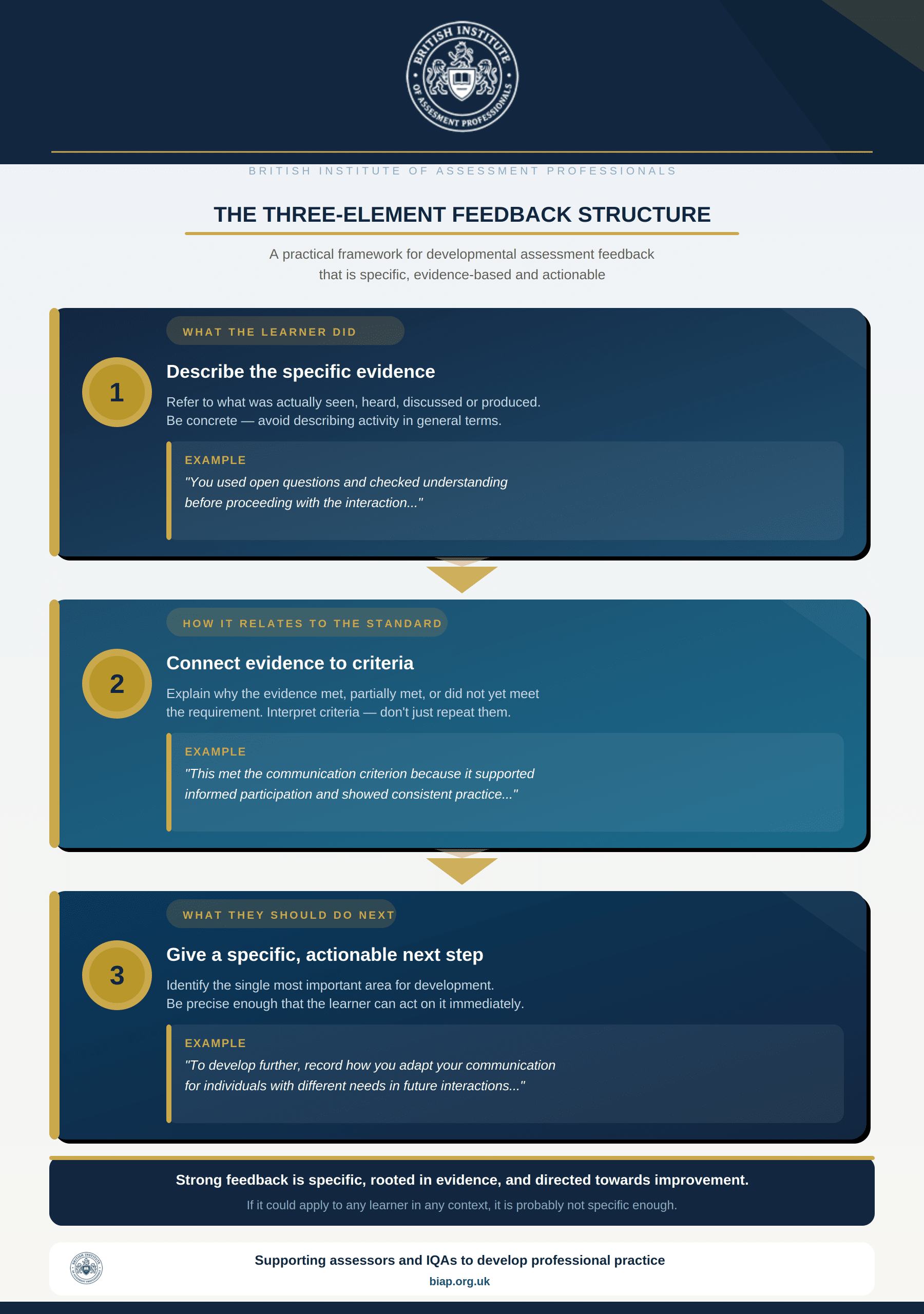
The Three-Element Feedback Structure
Describe the evidence, connect it to the criteria, then give one actionable next step — a practical framework for developmental feedback.

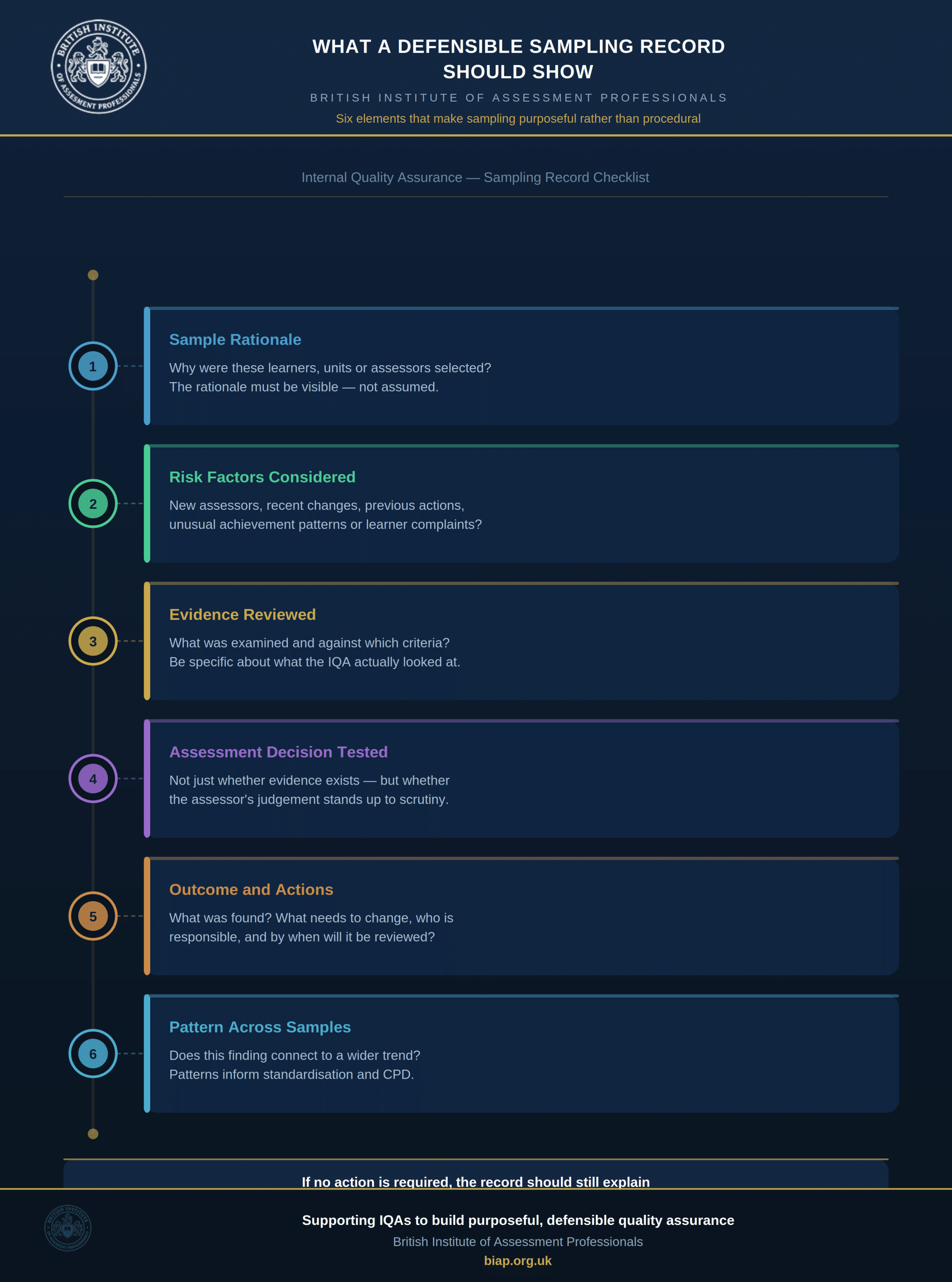
What a Defensible Sampling Record Should Show
Six elements — from sample rationale to patterns across samples — that make an IQA record purposeful rather than procedural.

What Assessors Need to Record
Four record types — observations, professional discussions, feedback and assessment plans — and what every entry must include.