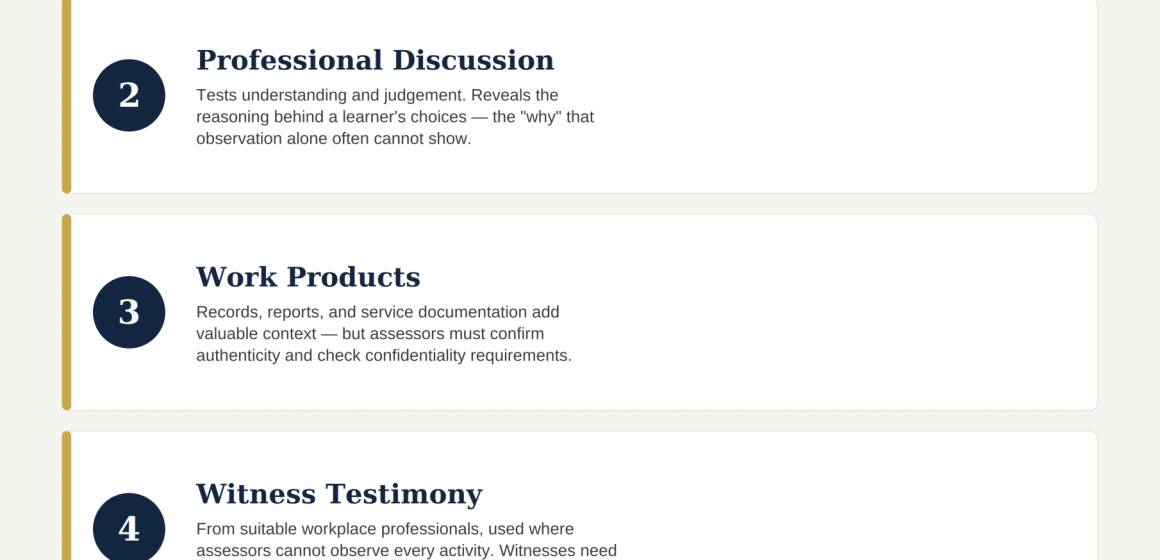
5 Sources of Occupational Competence Evidence
A learner completing a task successfully is not, on its own, proof of competence. Assessors need evidence that shows what happened, how it happened, and why it meets the required standard — and no single evidence source can carry that weight alone.
This infographic sets out the five sources that strong occupational competence evidence typically draws on, and why combining them deliberately produces more defensible assessment decisions than relying on any one method in isolation.
Direct observation remains the clearest window into practical performance. Watching a learner complete real workplace tasks — including how they respond when conditions change unexpectedly — offers assessors evidence that staged demonstrations rarely match.
Professional discussion fills the gap observation leaves behind. It tests a learner’s understanding and judgement, revealing the reasoning behind their decisions rather than just the outcome.
Work products — records, reports, and service documentation — add valuable context to an assessment. However, assessors must always confirm authenticity and check confidentiality requirements before relying on them.
Witness testimony extends an assessor’s reach into situations they cannot personally observe. Suitable workplace professionals can provide first-hand accounts of a learner’s performance, provided they are given clear guidance to comment on specific behaviours rather than general impressions.
Learner accounts complete the picture, giving learners the opportunity to explain their own decisions and demonstrate reflective learning in their own words.
Together, these five sources support assessment decisions that another competent practitioner could follow and trust. For assessors and IQAs working across vocational qualifications, understanding how and when to use each source — rather than defaulting to whichever is most convenient — is central to sound, standardised practice.
BIAP supports assessors and IQAs across the UK vocational education and skills sector with resources, professional recognition, and standards-based guidance that strengthen assessment practice and professional credibility.
Download the infographic below for a quick-reference summary you can share with your assessment team or keep on hand during CPD and standardisation sessions.